All That Glitters: A Response to Stephen Wolfe's Denunciation of Michael Spangler
Stephen illustrates for us that those who want to take a non-confrontational stance toward these issues cannot avoid attacking their White and Christian brothers as a result.

A few months ago in March, Stephen Wolfe, author of The Case for Christian Nationalism, publicly disavowed his former friend, pastor Michael Spangler (also the managing editor of this journal). My purpose here, aside from supporting Michael whom I consider a friend, is to discuss this event in terms of its meaning for Christian Nationalism as a discrete political movement. I will argue that the action explicitly violates several of the measurable standards which I set out to use to judge its effectiveness and suitability for addressing the issues we face.
In my first series for American Mantle, “An Open Letter to Christian Nationalism from a Former White Nationalist,” I explained that my use of the terms “White Nationalism,” “Alt Right,” “Christian Nationalism,” and “New Christian Right” (henceforth WN, AR, CN, and NXR) referred not to principles or policy positions, but distinct groupings of individuals, organizations, and political-cultural affiliations. The reason for this is that ideas are ultimately put into practice (or not) by specific people, in place and time, and thus having the right ideas is only part of the equation; the other part is the vehicle through which they are advanced. If the idea is a compass, then you still need a ship.
 Edwin Schliemann
Therefore, it is precisely because I believe in certain ideas and principles, that I am less sentimental about the labeling of the ship. I could unsentimentally make the assessment that White Nationalism, which I was previously involved with, had failed, not as a set of principles but as a distinct political movement, according to certain benchmarks and due to specific factors which I described in the first two essays of that series. I then laid out specific benchmarks or tools for measuring the success of CN/NXR, again not as a principle which is easy to agree with in the abstract, but as a concrete movement of people in time which is capable of success or failure depending on their actions. Of these, Stephen’s disavowal concretely violates my prescriptions on solidarity, race, and the Jewish question. I will now examine these in turn.
No Enemies on the Right
Stephen’s statement is important because he was one of the people I had in mind when I praised CN as having improved upon some of the internal issues which plagued the AR, in particular the application of the idea of “no enemies on (or to) the right” (NEOTR). I wrote that:
… the NCR is commendably superior to any similar effort in the history of WN. At core, NEOTR is a recognition of the reality of collectivism: the house divided against itself necessarily falls to the one that isn’t. Wisely, many CNs seem to have learned that by its very definition, NEOTR does not imply or require complete agreement. If someone is “on the right,” they recognize two things: that they prefer the right to the left; and that disagreements with others on the right are not to be resolved by playing to the center, thereby breaking solidarity and inherently undermining all parties involved by submitting the right to the judgment of holders of opposing principles. Rather, disagreements are to be worked through as necessary by leading through example, and putting ideas and strategies to the test through the freedom of internal discussion and the honesty of external struggle against common foes.
I wrote furthermore that this is “… a revolutionary principle, one that separates a movement capable of coalescing and oriented toward success from one which eschews both of those things from its outset.” The reason for this is that, by definition, only radicals are able to push the boundaries of a discussion and introduce ideas previously shut out or unexplored, by their willingness to martyr themselves: their careers, their relationships, and sometimes even their lives. The majority of a broad movement will only ever consolidate ground which they could not have gained, and if pushed on it, most would retreat. I am not talking here only about Stephen and Michael. Christian Nationalism, as a whole, received the ground it built on from the AR and WN, even those Christian Nationalists who would substantively disavow it, as I argued in the first part of my series.
One of the arguments I put forward was illustrating the adoption of memes and political ideas from the AR, on subjects as varied as nationalism, economics, race, the degeneracy of modern culture, and of course the Jewish question. For a specific example, in 2018, Stephen wrote an article entitled “It’s OK to be a Christian American,” utilizing the phrase first popularized as “It’s OK To Be White,” a White Nationalist meme which spoke truth to power by provoking a response which demonstrated that, for many people in power, it was in fact not OK to be White. Universities tried to use the FBI and police against their own students for constitutionally-protected speech, a response spurred on by far-left activists infamous for doxing and attacking people for their political views, in much the same way as Stephen’s statement was clearly spurred by the same tactics from the antifascist activist Eli McGowan, as illustrated in the screenshots below:
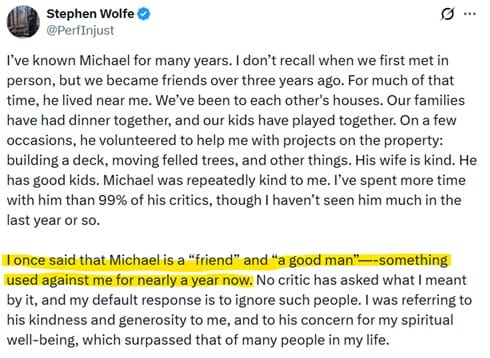
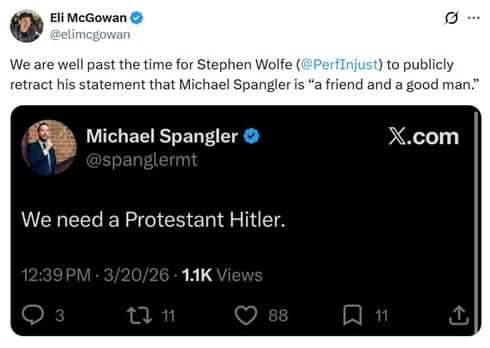
However, that specific example alone is far from the substance of my argument about the relationship between CN and WN. The more important relationship is not a matter of individual memes, but of structural logic, as described in my second article on NEOTR:
Secondly, it is the very fact of a radical position existing, out there, scratching at the door and doing everything it can to get in, that opens up space for more mainstream voices to indulge in political revisionism. This is what is sometimes called pushing the “Overton Window.” Perhaps some today got their nationalism, critiques of liberalism, their questions about the Allies in World War II, or their cautious Semito-skepticism, from Pat Buchanan, Paul Gottfried, Patrick Deneen, or Darryl Cooper. But paleoconservatism, always a questionably radical position in any case, had languished in defeat for decades, itself exiled firmly to the land of political taboo as “racist” and “Nazi.” Its return was enabled not because its adherents themselves pushed the envelope, but because they got the opportunity to point at Charlottesville and say, “Yes, we’re not Jeb Bush conservatives, but we’re not them, and who would you rather have?”... The very fact of the liberal system having to confront a genuinely radical set of ideologies which had forced itself into the public consciousness made everything in between less punishable by default.
This is not an arbitrary connection, but a law of cause and effect which exists independent of any specific ideological substance. Therefore, how you personally judge a specific idea is completely irrelevant to the wider consequences of the action of turning to stand with the enemy against those to one’s right, friends or otherwise.
Race and the Jewish Question
It is instructive now to examine Stephen’s statement and its immediate context. Michael posted a thread on X arguing that “We need a Protestant Hitler” to combat leftism and Judaism, contending that such a figure is evidently more relevant to our current context in the United States than a “Protestant Franco,” and more convicting for American Christians than a new King Josiah, as it requires confronting the godlessness of the Jews and America’s complicity in the post-war order through its alliance with communism against National Socialist Germany. Stephen’s statement was posted directly in response to a tweet from that thread, in which Michael says that “Protestant Hitler” is the right term for the Christian prince we need today.”
I personally agree entirely with Michael’s thread. Stephen obviously does not, and his disavowal dismisses the relevance of Hitler, “Naziism,” and “1930s German history” (which he claims, amazingly, is “unnecessary to critique the “post-war consensus,”” a concept defined exactly by its rejection of the principles of fascism and National Socialism which World War II was singularly fought to defeat). Instead, Stephen says that “We need a George Washington.”
As with the previous point, an in-depth argumentation of the specifics of Stephen’s view, as he presents it, is not necessary. What is clear is that he is rejecting the primacy of the related issues of racial nationalism and anti-semitism.
These are both, again, specific benchmarks which I set for Christian Nationalism in parts 3 and 4 of my Open Letter series. Whites in America are subject to a sustained and intentional campaign of ethnic displacement, cultural and historical erasure, and political disenfranchisement, which has been ongoing since at least the Civil Rights era, if not much longer. This has become undeniable to the point that all of politics is increasingly dominated by the pull of this issue. I believe that a substantial portion of Stephen’s audience are White men and women who subscribe to him and his ideas because they hope those will be a stepping stone to resolving the real problem, which is the demographic and political displacement of White Americans. Anecdotally, I know many view Stephen’s work positively as an advancement towards the ideas and politics which are actually necessary. Perhaps he knows this, and it irks his pride. It shouldn’t; as I’ve written elsewhere, we have no right as individuals to center ourselves in what is a multi-generational and collective conflict to liberate our posterity from our present conditions. His self-imposed rift with Michael indicates that he intends to firmly plant himself in a middle ground which popular consciousness will only ever treat as a means to a more radical, and just, end. To the extent that this permanent surrender on race becomes the party line of Christian Nationalism, it will be another marked defeat, as I wrote:
CN will either take the lead on this issue, or cede the current opportunity to do so and the righteous cause to another group. Until the attack on White people is faced head-on and decisively defeated, such that it cannot be mounted again, this issue will remain essential and ever more urgent, and any movement that fails to make it a cornerstone will be crushed by it, and along the way will have wasted not just time, effort, resources, and opportunities, but in fact substantively contributed to the further humiliation and suffering of our people at the hands of our enemies.
The case is much the same with the Jewish Question, which I wrote can be understood as: “the realization that we are confronted with a group which, by all evidence of history, observation, the witness of Scripture, and what the Jews say about themselves, is by nature both opposite and oppositional to us, the White race.” I would refer the reader to my article where I provide the evidence. This is particularly relevant in the United States, under our Zionist Occupied Government which openly sacrifices our White children as cannon fodder for Israel’s geopolitical ambitions and as victims for Jewish pedophiles. The Jewish occupation is the primary contradiction which our political movement must confront; all other issues are downstream of it, and we cannot expect God to bless us if we falter in this task.
With these issues established, one should ask, what exactly is Stephen fighting for? If it’s not the explicit carving out of a politically sovereign homeland for America’s White ethnos, then it’s dust in the wind. If that is his real desire but he thinks it is imprudent to be honest about it, he is both woefully misreading the times, and should receive conviction from the actions which this belief has now led him to, in attacking Michael to curry favor with lesser men. The only other option is that he consciously supports the passing of the White race.
Pursuing the Required Confession
I want to briefly address the idea that Stephen has a unique claim over some element of Christian Nationalism. I think this is not entirely without merit, due to his book and its impact. He helped popularize the phrase; and I can also grant, if only for the sake of argument, that he similarly popularized the term “Christian prince,” which Michael uses in his tweet about Hitler. However, he again misunderstands politics in the way he attempts to enforce a monopoly on its use. The true meaning of “Christian prince,” or any political-philosophical concept which aims to provide a roadmap for physical action, can never be fully delineated through theory; it must be discovered, or unfolded, in conversation with reality through its attempted application. The most durable, and valuable, ideas are precisely those which are capable of adaptation and evolution in their non-essential characteristics, due to the degree to which their truly essential characteristics are in concord with fundamental aspects of reality. This really boils down to the pursuit of truth, or more precisely, of the required confession, which is “that truth which is most under attack, most uncomfortable, or most important for confronting a current enemy attack.” Michael’s thread is an excellent example of doing just this, as through reason he unfolds the justification for why a Christian prince should be a Protestant Hitler, rather than a Franco or Josiah, in order to most directly, effectively, honestly, and penitently confront our current problems.
If Stephen thinks Hitler was neither an example nor a model for a true “Christian prince,” he has to make that argument by engaging directly with Michael’s reasoning in good faith. This would also require engaging with questions such as the truth of the post-war consensus and its narrative around National Socialism, Hitler, and the holocaust, and the nature of Jewish-Gentile relations. Stephen explicitly says that he does not want to do this, without reference to its actual truth content. Instead, he makes reference only to his own personal convenience, and maybe some kind of aesthetic preference. The reader can judge this for themselves from Stephen’s words:
I have no interest in retrieving Naziism, nor do I want a “Protestant Hitler.” Michael knows this, as I’ve said to him (among others) that revising 1930s German history is unnecessary to critique the “post-war consensus”. I am right-wing, but I am an American. By today’s standards, American history is right-wing, and it contains all the resources for recovering a manly, moral liberty and a Christian society. Anglo-Protestantism, despite its faults, is still the core tradition of America. Our fight is to recover it.
I have a high tolerance for differing opinions. I do not shy away from references to Marx, Nietzsche, Hegel, Heidegger, or “critical theory.” Viewing everything with the good/evil binary, or relying on a set of scary words to categorize intellectual history and various individuals, is unserious. I even use Marx in my MA philosophy thesis. But I would not say that we need a “Protestant Marx” or a “Protestant Heidegger”. We need a George Washington.
To any honest observer, there are far too many weighty and relevant assumptions baked into Stephen’s statement to justify such a flippant dismissal. I will name just one: the glossing over of America’s alliance with communism and direct role in setting up the very post-war consensus Stephen purports to criticize, through the faux-patriotic identification (“but I am an American”) contra National Socialist Germany. Indeed this is precisely part of Michael’s argument for the necessity of a “Protestant Hitler” in the first place. In effect, Stephen is saying that he too would have stormed the beaches of Normandy, even with the benefit of hindsight. More to the point, he is assuming the conclusion and treating it as an argument for dismissing something he clearly simply does not want to deal with. His personal opinions on a “Protestant Marx,” “Protestant Heidegger,” or “Protestant Hitler” are just not relevant if he is not willing to actually test them through honest dialogue, when prompted by relevant issues or circumstances. The idea that Michael’s pursuit of truth and the required confession should be limited by Stephen’s convenience—which he implies by calling Michael’s language a personal and intentional “betrayal”—is absurd.
Much of Stephen’s tweet consists of references to personal costs which he bore due to the association with Michael. He does not specify what the substance of the cost to his family is, nor really to himself; one is left to infer that this may be some mix of people occasionally asking him in person about Michael, and lost professional opportunities. He still does plenty of public appearances at conferences, but I suppose he may still feel his purse light a few silver coins. He also clearly feels that his brand of “Christian Nationalism” is hurt by the association with Michael made by antifascists like Eli McGowan. It’s also very likely that he feels aggrieved that the institutional church might judge the acceptability of his ideas not by their content but by the content of Michael’s tweets, and as a result is willing therefore to throw his “good friend” to the wolves in order to accommodate men so lacking in reason and justice.
Conclusion: The Road Goes Ever On
Stephen illustrates for us that those who want to take a non-confrontational stance toward these issues cannot avoid attacking their White and Christian brothers as a result, and precisely those men who are willing to face directly the most pressing problems of the day, and continue making a breach in the enemy lines. What should he have done? Simply nothing. Sometimes, just looking the pressure to conform on an issue in the eye and refusing it is all the courage that’s necessary. Very often, half of the battle is won by simply keeping your cool. But Stephen blinked. Undoing the damage is possible, but it would take a public repentance, apology, and reversal. The point of his action was its public nature. The public breaking of solidarity is where the greatest damage lies.
To conclude, I will largely copy a statement I made a little while ago on X about this situation. If you stick around long enough in politics, you will observe a cyclical pattern. Stephen and others like him rode a wave of nationalist consciousness which they did not create, but inherited from the Alt Right. Hubristically, now that the sun is shining, they imagine themselves more important than they are, and cut off people like Michael to protect their current position, which is more ephemeral than they understand, and dependent on people more principled, radical, and far-seeing than them to be martyred in defense of. In reality, nothing has changed in the power structure of the American state, or of most American churches. All of the original contradictions of the system, such as Jewish power and the subjugation of Whites, are still in place, and genuine radicals will eventually be able to make the same arguments against Stephen as they did against people like Doug Wilson, or against Christian Nationalism as they did against the Republican Party, if Christian Nationalism as led by people like Stephen continues seeking to merge with the GOP. New moderates will ride the coattails of such radicals again.
This can feel like a Sisyphean exercise, but what is important is that with each iteration, there is an advancement in the permeation of racial consciousness and the creation of independent institutions. In my view, the amount of Protestants who now have a political consciousness on race and Zionism fit for revolutionary political activity (even if they are not a majority of those who would self-describe as Christian Nationalists); institutions like American Mantle and Sacra Press built by men like Michael Spangler and Cody Justice; and rise of men like Michael and Samuel Ketcham who are willing to suffer persecution from the church without surrender; —these are the real signs of advancement. Another success is the existence of churches which will not throw out men for their questioning of the Nuremberg historical mythos, and here I would give credit to pastors like Joel Webbon, and a few others.
The fight goes on, and will continue to do so until our people cease to exist or are freed. The real lesson of “no enemies on the right” is that you cannot fool God, who in his providence has so crafted the universe he created that even in its current fallen, sinful state, it will always, inevitably, chew up and spit out cowards and traitors.
Stephen, like all of us, you are part of something much greater than yourself, and will be for as long as you live. You cannot extricate yourself from this responsibility, or from the laws of cause and effect which the divine Author inscribed on the universe of his creation. The world you want to remain a part of glitters, but it is not gold, and the coming fire will not purify it.
ATTENTION READER:
American Mantle exists for the renewal of godliness and righteous power in America. We often go where others rarely dare, directly addressing taboos on faith, ethics, politics, and history.
We are Americans by blood and soil. Our own forefathers conquered and cultivated our homeland, and through great faith, bold strategy, and statesmanship secured the blessings of liberty to themselves and their posterity. We are their posterity, and we resolve to follow them. Join us in this mission.
Donate now to support us.