Great Americans: Hannah Duston—Valiant Avenger of Colonial America
The woman who scalped her Indian captors.
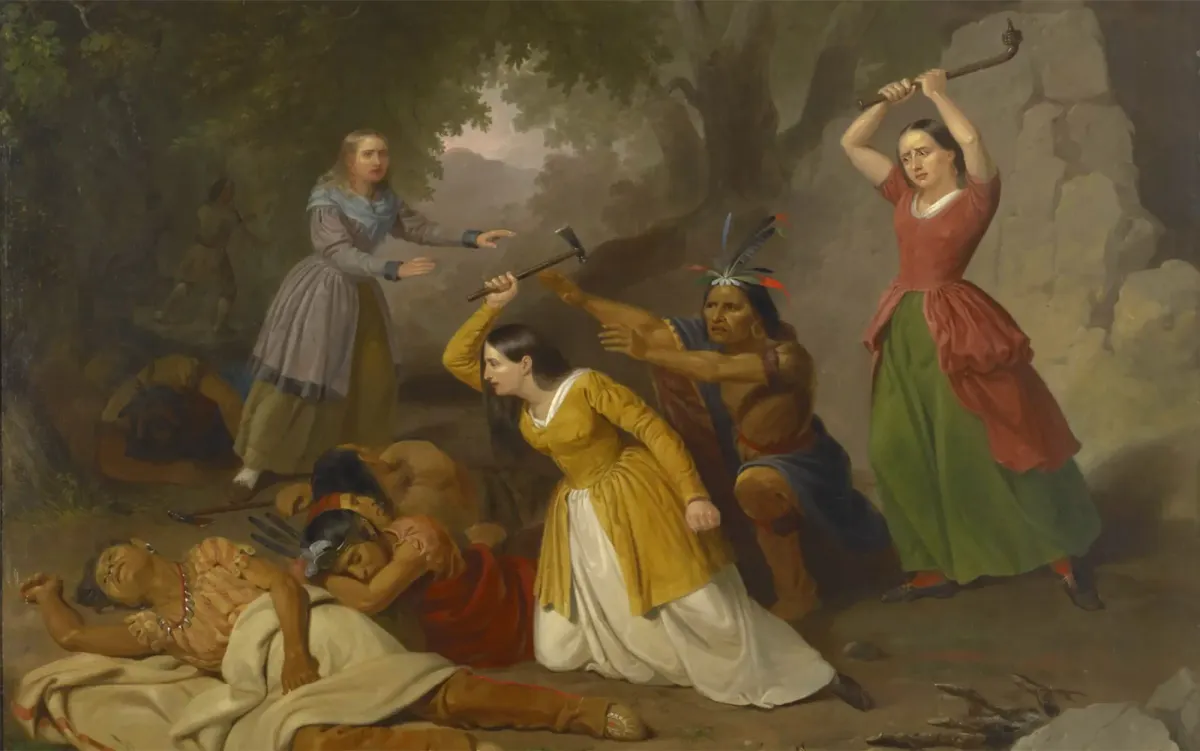
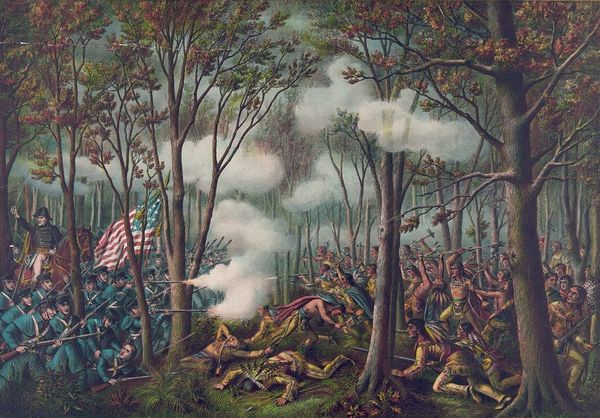
On March 15th, 1697 on the outskirts of Christendom, the small hamlet of Haverhill, Massachusetts was attacked by vicious Indian raiders. Twenty-seven Americans, half of them children, were mercilessly slaughtered. A 40-year old woman, along with her nurse, newborn daughter, and ten others were taken captive and driven north. That woman’s name was Hannah Duston, and her harrowing captivity and righteous vengeance over the next month and a half would inspire five memorials and countless Americans throughout the centuries.
Hannah’s husband, Thomas Duston, was working on a new brick home about a half mile away at the time of the raid. When he became aware of the attack, he sped back home just in time to warn his children to flee toward the local garrison. Entering his home, he frantically alerted his wife. But Hannah, who had given birth just six days prior, was unable to move before the Indians were upon them. Thomas, upon seeing his seven vulnerable children running away from their homestead, determined to protect them from the oncoming Indians and cast the rest upon the Lord. He initially planned to take one or two of the children with him upon his horse and return for the rest if any remained. But in a fit of agony at already leaving his wife and youngest behind he determined to save all that remained or die trying. Shielding his children with his own body and that of his horse, he exchanged fire with the Indian marauders for over a mile until they all safely reached the garrison.
Meanwhile, Mrs. Duston was taken into brutal captivity and forced to watch as her homestead was burned and possessions looted. Despite her recent childbirth, she was prodded into keeping up with the Indian braves as they fled with their wicked harvest of stolen goods and English captives. Before long, the savages were able to recognize which Americans were capable of making the long trek into Quebec to be sold to the French. Those who were not fit for the journey were swiftly dispatched with a hatchet to the back of the head and left to rot where they fell. Hannah’s six-day-old daughter was one of these poor souls, her head cruelly dashed against a tree. Hannah and her nurse, Mary Neff, were forced to silently watch these acts of murderous barbarism against their family, friends, and neighbors. They knew that the only thing keeping them from the same fate over the coming weeks was the whims of their attackers and the grace of Almighty God. Throughout those long and dismal days, Hannah kept her eye on the savage who murdered her infant, keeping in mind the words of the Psalmist, “Judge me, O God, and plead my cause against an ungodly nation: O deliver me from the deceitful and unjust man.”
And the God of vengeance answered her prayer. Cotton Mather describes Mrs. Duston’s tale in Volume 2 of the Magnalia Christi Americana:
“Nevertheless, the poor women had nothing but fervent Prayers, to make their Lives comfortable or tolerable; and by being daily sent out upon Business, they had opportunities together and asunder, to do like another Hannah, in pouring out their Souls before the Lord: Nor did their Praying Friends among our selves, forbear to pour out Supplications for them. Now, they could not observe it, without some wonder, that their Indian Master, sometimes, when he saw them Dejected, would say unto them; ‘What need you Trouble your self? If your God will have you Delivered, you shall be so!’ And it seems, our God, would have it so to be!”
At the end of April, the Indians were sleeping soundly, content with the thought that their three poor captives would never bring them any harm so far into the wilderness of Indian territory. But Hannah Duston, along with her nurse Mary Neff, and a 14-year-old English boy named Samuel Lennardson, took hatchets against their savage captors and slew them. Duston ensured that the first to die was the one who had murdered her child. By the end of the slaughter, ten Indians—two men, two women, and six children—lay dead where they had been sleeping. Hannah and her companions then scalped the bodies and fled south toward home and civilization.
Colonial American government adopted the Indian practice of scalping and instituted it into a bounty system for the enemies of Christendom. Off and on, American states offered such bounties on Indian scalps until 1863. The bounty on Indian scalps in Massachusetts had been temporarily repealed a few months prior to Hannah Duston’s captivity. However, her husband appealed to the court for compensation regardless, stating:
“That the wife of ye petitioner (with one Mary Neff) hath in her Late captivity among the Barbarous Indians, been disposed & assisted by heaven to do an extraordinary action, in the just slaughter of so many of the Barbarians, as would by the law of the Province which [only] a few months ago, have entitled the actors unto considerable recompense from the Publick. That tho the [want] of that good Law [warrants] no claims to any such consideration from the publick, yet your petitioner humbly [asserts] that the merit of the action still remains the same; & it seems a matter of universal desire thro the whole Province that it should not pass unrecompensed. "
Thankfully, the state recognized the merit of Mrs. Duston’s service and the value it had for the fledgling American community. They rewarded the trio a total of 50 pounds, about three and a half years of the average American’s wages at the time. What a blessing it can be when the governing authorities reward righteousness and punish evil.
The authorities currently over the land of Hannah Duston now do the exact opposite. A bronze memorial commemorating Mrs. Duston was erected in Haverhill’s town square in 1879. The memorial centers around a bronze statue of stern-faced Hannah Duston holding a hatchet and pointing an accusatory finger down at the city. This memorial is still standing, despite the efforts of the enemy to remove it. I had the honor of visiting this memorial some time ago, but to my dismay discovered that the enemies of our nation had been partially successful. The statue remains, but the hatchet in Hannah’s hand has been removed. The message to Americans cannot be more clear: “You may remain for now, but we will disarm you, we will disarm your women, and then you will be helpless to stop us.” The gaze of the disarmed Duston matron accuses not just the city, but every American who stands before her. “Look before you and see one who has given so much more for our people than anyone you know.”
After Mrs. Duston and her company returned, she met with the preeminent Puritan minister Cotton Mather and recounted her tale. He was so taken with it that less than two months after Duston was taken into Indian captivity, she entered Mr. Mather’s church to hear a sermon recounting the Lord’s deliverance through her own trials. The essence of the sermon can be distilled in a single line from Mather, “That when a Sinful People Humble themselves before the Almighty God, it is an Hopeful and an Happy Symptom, that He will not utterly Destroy such a People.” Mather preached humility and repentance for sins ranging from increasing apostasy, to decaying family discipline, to falsehoods and slander. Unfortunately, these sins of our fathers have not decreased, but grown rampant in our land since the time of Duston and Mather. Thankfully, the prescription remains the same: repent and humble yourself before the Lord in fear and trembling, knowing that he is faithful and just to cleanse us from all unrighteousness. Cotton Mather’s words ring just as true today as they did nearly 330 years ago:
“What you shall render to the Lord for all His Benefits? And you will sincerely Render your very Selves unto the Lord: You are not now the Slaves of Indians, as you were a few Dayes ago; but if you continue Unhumbled, in your Sins, you will be the Slaves of Devils; and, Let me tell you, A Slavery to Devils, to be in Their Hands, is worse than to be in the Hands of Indians! I beseech you then, by the Mercies of God, that you present your selves unto the Lord Jesus Christ; Become the sincere Servants of that Lord, who by His Blood has brought you out of the Dungeon, wherein you were lately Languishing; Oh! Deny not the Lord, who has thus Bought you, out of your Captivity.”
Mrs. Duston was raised in a Christian home and baptized in her youth, but did not seek church membership nor take the eucharist until her 67th year. In a letter to the elders of the Second Church in Haverhill, Massachusetts, she writes that she greatly desired the Lord’s supper, but abstained due to fears of her own unworthiness. After mentioning the impact a sermon on Luke 14:17 had on her, she writes; “But I desire to delay no longer, being Sensible it is My Duty-, I desire the Church to receive me tho' it be the eleventh hour; and pray for me— that I may hon'r God and obtain the Salvation of my Soul.” Hannah mentions her time with her Indian captors in the letter as well. With words effusing humility, she writes;
“I am Thankful for my Captivity, twas the Comfortablest time that ever I had; In my Affliction God made his Word Comfortable to me. I remembered 43d [Psalm]— and those words came to my mind—[Psalm] 118:17.”
In times of strife may we all have the humility and grace of the noble Hannah Duston. And may we remember the same words that comforted her, “I shall not die, but live, and declare the works of the Lord.”
For further reading I highly recommend Jay Atkinson’s work Massacre on the Merrimack. While a modern work, it avoids falling into the trap of over-sympathizing with savages, and accurately portrays Mrs. Duston’s situation, with one chapter of explanation for the situation of the Indian tribes at the time.
Reference
- Cotton Mather. Magnalia Christi Americana / 2. Hartford, Andrus, 1853. Appendix, Article XXV.
- http://name.umdl.umich.edu/A50133.001.001
- Atkinson, Jay. Massacre on the Merrimack : Hannah Duston’s Captivity and Revenge in Colonial America. Guilford, Connecticut, Lp, Lanham, Maryland, 2017.
- https://web.archive.org/web/20210415052755/http://www.hawthorneinsalem.org/Literature/NativeAmericans&Blacks/HannahDuston/MM2097.html
ATTENTION READER:
American Mantle exists for the renewal of godliness and righteous power in America. We often go where others rarely dare, directly addressing taboos on faith, ethics, politics, and history.
We are Americans by blood and soil. Our own forefathers conquered and cultivated our homeland, and through great faith, bold strategy, and statesmanship secured the blessings of liberty to themselves and their posterity. We are their posterity, and we resolve to follow them. Join us in this mission.
Donate now to support us.