A New Nobility of Blood and Soil: Christianity and Inheritance
What can Christians learn from a Nazi?

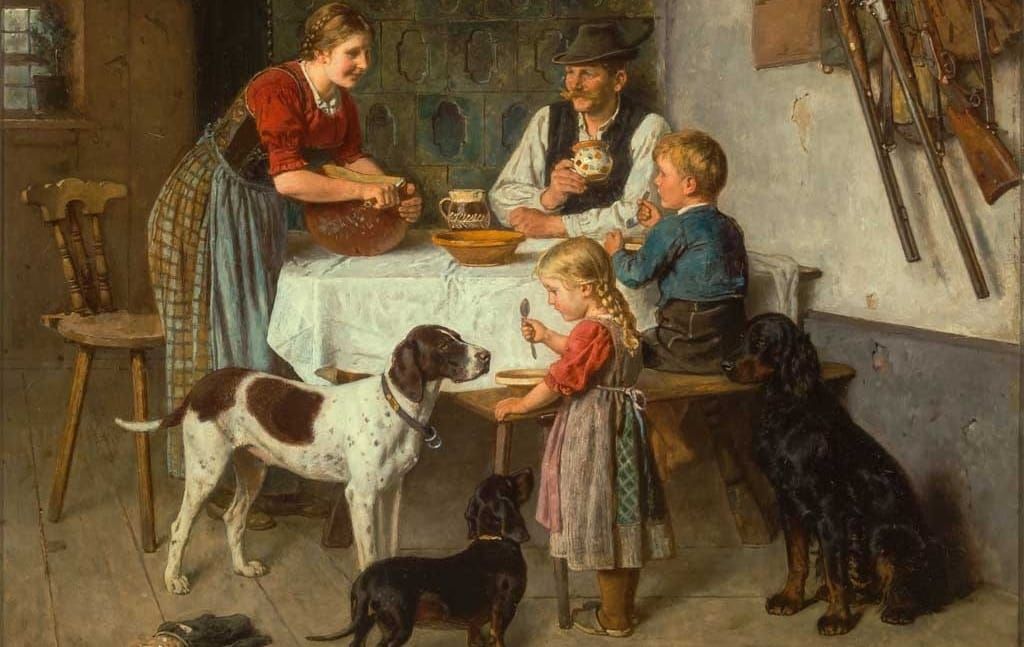
Richard Walther Darré’s A New Nobility of Blood and Soil, written in 1930 and recently republished by Antelope Hill, explains the political, economic, and social principles that Darré believed ought to govern a healthy society. The book is a critique of modernity focused on blood and soil: ancestry, family, inherited responsibility, and rootedness in the land. Darré raises important questions about industrialization, urbanization, the weakening of family structures, the alienation of labor from land, and the tendency of modern political systems to detach individuals from inherited communities. I’ll sketch out some of his profound insights, and then I’ll assess where he goes wrong.
I. Agrarianism and the Problem of Modernity
Darré’s argument has an interesting parallel in the American Southern Agrarian movement. In the very same year that Darré published his book, a group of writers associated particularly with Vanderbilt University published I’ll Take My Stand, a critique of modernity, urbanism, and industrialism in American, and especially Southern, culture. The book initially sold only a few thousand copies, but its ideas on the centrality of agrarianism to culture have continued to resonate. Wendell Berry is a recent representative of this tradition.
The basic agrarian proposition is that culture is inseparable from man’s relationship to the soil. I’ll Take My Stand describes an agrarian society not as one without industry, scholarship, art, professional occupations, or cities, but as one in which agriculture remains the leading vocation and receives economic preference. The concern is that industrial development can become so dominant that it subordinates agriculture and the folkways associated with it.
Darré develops a much fuller version of the agrarian argument. For him, the connection between blood and soil is not merely cultural or economic; it is hereditary. A people becomes what it is through generations of families rooted in a particular place, and the preservation of that people requires institutions that protect hereditary continuity with the land.
II. Christianity and the Loss of the Old Nobility
Darré argues that Christianity displaced the old nobility of ancestry, and now hereditary nobility must be reconstituted. In his account, the German nobility began to lose its original character with the conversion of the German peoples to Christianity. He points particularly to Clovis as the first of the German nobles to convert.
Christianity teaches that all men are sinners and all are in need of the Savior. Religion is universal; nationhood is particular. Darré interprets the social consequences of universal Christianity as undermining the distinctions on which political authority depends. He therefore wants to recover what he regards as the valuable elements of the older order without, in his conception, simply returning to paganism. His stated objective is not salvation by race but the restoration of social order.
Darré’s argument is not simply, “Christianity must be rejected and paganism restored.” Rather, he attempts to appropriate certain Christian moral concepts while rejecting what he sees as Christianity’s leveling implications for political and social organization. Keep in mind that the egalitarian mania of alienist “Christians” today is very much like what Germany faced in the 1930s from Communist infiltrators and heretics like Bonhoeffer who were trying to steer churches towards liberalism.
Germans have always prized order and resisted disorder. Darré shows that the loss of nobility is what produced a loss of order. The problem he seeks to solve is how to recover a social structure capable of preserving inherited distinctions while maintaining responsibility towards the community.
III. The Pre-Feudal German Community
He begins by looking behind medieval feudalism to what he regards as the older Germanic community.
In his view, the pre-Christian German peasant was not originally a serf or a socially degraded laborer. He was attached to his household and land and possessed a position of honor and relative freedom. The family, rather than the isolated individual, was the fundamental social unit.
He illustrates this through the symbolism of the hearth. The transmission of blood from one generation to the next was associated with the continually burning family fire. In one Germanic custom, a purchase of land did not become legally binding until the purchaser extinguished the previous hearth fire and rekindled it. The legal transaction was therefore symbolically incorporated into the continuity of the household.
Darré compares this with ancient Rome, which initially recognized inequality in terms of blood and later transferred much of this distinction to property ownership. In both Rome and pre-Christian Germany, however, the extended family remained fundamental. Land had meaning primarily because it belonged to a family and village; it was not simply an abstract commodity.
The hereditary seat provided social stability for the community. Darré particularly emphasizes primogeniture: the eldest son inherited the family seat, was expected to marry, maintain the household, and demonstrate himself worthy of the inheritance. Marriage and inheritance were connected, and social expectations functioned as filters through which the most capable members of successive generations were selected to marry and continue the family line.
Darré compares hereditary selection to fertilization: many potential candidates among the sperm compete, but only one reaches the egg. Hereditary institutions likewise serve to preserve and improve the quality of the family line from one generation to the next.
IV. Feudalism
Darré argues that the conversion of the Germans, particularly through men like Boniface, transformed this older social order. In his account, church and state became intertwined, and feudalism emerged. He attributes an important role to the church in the development of the fief system and argues that the resulting structure eventually contributed to the formation of the German Empire.
Under feudalism, nobility became increasingly associated with property ownership and less connected to hereditary membership in the community of extended families.
Darré’s objection is not merely that feudalism produced inequality. He believes that it produced the wrong kind of inequality. If the head of a household can dispose of property independently of the family, then the authority of the individual has effectively been placed above the family. Once this happens, marriage becomes a contract between individuals rather than a responsibility to kin, and particularly to descendants.
Darré connects this development to declining birthrates, arguing that the separation of marriage from hereditary landholding weakened the incentives and obligations that formerly sustained large families. He points again to ancient Rome, arguing that attempts by Caesar to reverse declining fertility ultimately failed, in part because urban life itself worked against the agricultural family.
He sees the same basic process in medieval Europe: the separation of blood, family, inheritance, and land weakened the old social order.
V. Militarism and Urbanism
Darré gives a specific meaning to the word “people.” He rejects the idea that a people is simply the numerical collection of individuals living within a political boundary. Instead, he defines the people in terms of common ancestry and commitment to German identity. In his view, if nobility is hereditary, the people themselves must possess hereditary character.
From this perspective, Darré regards feudalism as destructive of older communal traditions. He even suggests that the feudal system was deliberately introduced to Germany for this purpose.
The fief system created new classes of warriors and peasants. Agricultural labor became socially inferior to military service, while the warrior became economically dependent upon the feudal lord. Darré characterizes this relationship as a form of slavery, contrasting it with the earlier free peasant who fought with his own weapons and marched on foot.
The rise of the knightly class, in his interpretation, drew the strongest men away from agriculture and toward warfare. This contributed to a growing separation between military and agricultural society and, eventually, between urban and rural life. The wealth associated with military vassalage also encouraged the wars that characterized later European history.
Darré finds a similar pattern in Rome. He observes that Roman peasants were released from bondage and given citizenship, but then became subject to taxation that they could no longer afford. Many therefore moved into the cities, while large estates accumulated in fewer hands. He appeals to Pliny’s description of large landholdings as part of the explanation for Rome’s decline.
When Roman society began to deteriorate, writes Darré, people attempted to preserve themselves and their possessions through what they called conservatism. The parallel he draws with modern politics is deliberate: societies tend to respond to structural decline by attempting to conserve what remains rather than addressing the causes of the decline.
VI. Nobility
Darré does not regard centralized political authority as wholly negative. He believes the emperor performed a useful function because, without some form of central authority, the largely self-governing German communities would have lacked a unified German state capable of defending itself against external threats, such as Asiatic invasions.
His ideal society is therefore neither radical individualism nor complete social leveling.
He describes the traditional noble society as one in which people could possess equal rights while bearing unequal responsibilities. A man’s duties varied according to his hereditary position. Darré insists that this should not be confused with caste. In his terminology, caste exists where distinct races occupy the same territory and one rules over another, with the purpose of preventing racial admixture.
Darré is particularly concerned that nobility not become detached from the peasantry. When feudal lords granted fiefs, land ownership became the practical basis of political power. An upper class, he argues, is not necessarily a nobility. A genuine nobility must transmit its qualities from generation to generation.
This is also why he thinks democracies can flourish temporarily but eventually decline culturally: political institutions can preserve power for a time without necessarily preserving the character required to sustain a civilization.
VII. Village or Commune
Darré contrasts the German village with the Russian mir, which he interprets as a proto-Communist institution. In his description, the Russian mir collectively bore its tax obligations and distributed land among its members, while the German village subordinated the individual to the family and the family to the larger tribe or community.
These are two vastly different conceptions of social organization. In Darré’s account, the German model begins with the family and builds outward; the Russian model begins with the collective and distributes downward.
Darré extends this criticism to liberalism. He argues that liberalism abolishes traditional blood obligations while attempting to preserve private property, and therefore ultimately approaches Marxism from the opposite direction. He claims that both Marxism and liberalism damaged German agriculture, while capitalism encouraged the concentration of land in the hands of large owners. In both cases, he believes, the result is the destruction of the peasant system and an increasing separation between social classes.
He attacks Marx’s characterization of peasant agriculture as lazy and irrational, arguing instead that the peasantry has historically been a source of nobility. In this respect, his argument overlaps with elements of the agrarian thought of Thomas Jefferson and John Taylor of Caroline, who likewise associated independent agriculture with republican virtue.
Darré cites Ernst Hasse’s claim that heroes come from the countryside while the “mass-man” comes from the city. He connects this with Nietzsche’s criticism of the weak, insecure, and decadent masses.
The city itself receives some of Darré’s strongest criticism. He describes it as a polyp that draws nourishment from the surrounding countryside and concludes that urban existence is fundamentally parasitic. He therefore doubts that an urban society can provide a stable foundation for the kind of hereditary nobility he wants to establish.
VIII. The Hegehof
Darré’s proposed solution is the Hegehof, which is roughly a protected or nurtured hereditary manor or farm. This concept combines land, family, inheritance, and political responsibility. The Hegehof is not simply private property. Its holder is supposed to understand himself as a trustee of the community.
Darré imagines noblemen selected partly according to character and reputation, much as Scripture describes qualifications for church elders. These men would administer agricultural cooperatives within a hierarchy of institutions extending from the household through chambers and councils to larger territorial and regional structures.
The hereditary estates would not be freely alienable. A nobleman could not simply sell his Hegehof to the highest bidder. Darré sees this as a necessary limitation on free trade and compares it to the biblical Jubilee, in which Israelite land ultimately returned to its ancestral family.
The landholder, therefore, would possess land without possessing an unlimited right to dispose of it. He would hold it in trust for the family and the larger community, while the community would retain the authority to object and seek restitution if he failed in his obligations.
Darré sees this as an alternative both to capitalism and Marxism. Marxism is based on the redistribution of income; capitalism is based on non-productive debt that becomes an ever-greater burden to future generations, eventually forcing the family to sell its ancestral land. Under capitalism, land is merely another freely transferable commodity that ultimately becomes concentrated in larger holdings. Darré instead emphasizes moral alignment between the owner and the community.
His ideal economic structure is hereditary leadership supplemented by merit, just as he believes a fascist economy should be guided by the interests of the Volk while still allowing a controlled role for the market.
IX. Marriage, Inheritance, and the Family
Darré applies the same principles to marriage and reproduction.
He observes that hereditary noble titles sometimes passed through daughters when the male line died out. He interprets a decline in male heirs as possible evidence of a broader hereditary problem and speculates that women might therefore need to be excluded from the succession when male heirs disappear. The overriding principle is patriarchal.
He also proposes a system of social filters through which future leaders would pass: good hereditary background, compulsory military service, and professional training. These stages would test character and prepare men for marriage. The comparison with Robert Heinlein’s later Starship Troopers is striking: Heinlein likewise imagined citizenship and voting rights as privileges connected to honorable military service.
Darré wants members of the upper class to learn the trades of the lower classes, including agriculture. This would allow leaders to understand the work of those under their authority and judge the quality of that work.
He gives considerable attention to the older meaning of “breeding.” In modern English, good breeding generally means manners and social refinement, while breeding can refer simply to reproduction. Darré argues that these meanings were historically connected to family continuity and hereditary responsibility. He points to the Middle High German use of the word “chaste” in connection with the duty to breed and interprets this more broadly than the modern definition of sexual chastity.
For Darré, childbearing should not be treated merely as an exercise of individual self-determination. It is a responsibility toward God, one’s family, and one’s descendants. He quotes Euripides to reinforce the idea that sexual desire should be subordinated to the welfare of one’s children and family.
He contrasts this with modern sexual culture, which he believes has severed marriage from service to family and God.
He also observes that rape was historically understood not merely as an offense against an individual woman but against the woman’s family. He believes the church’s treatment of illegitimate children eventually shifted attention away from broader questions of family honor and toward the narrower distinction between legitimate and illegitimate birth.
X. Domesticity
Darré writes that separating women from land, family, and childbearing deprives them of the traditional responsibilities that gave their lives meaning. He associates modern professional life, contraception, and the separation of sex from childbearing with psychological and social disorder.
His picture of the professional woman is deliberately provocative. He describes affluent households in which two highly employed adults possess enormous kitchens that are scarcely used because neither person has time to cook.
For Darré, this is symptomatic of a broader dislocation from nature. When men and women are removed from the natural and familial structures for which they were formed, traditional distinctions between the sexes become unstable. He describes modernity as contributing to the feminization of men and the masculinization of women.
XI. Society as a Garden
Darré compares society to a garden. A garden does not merely consist in allowing everything to grow indiscriminately; the gardener must cultivate what is desirable and remove what interferes with it. Weeds compete with cultivated plants for air, water, and sunlight. Darré believes that social order requires comparable decisions about what should be promoted and what should be restrained. He associates this with spiritual and moral equilibrium.
He considers the example of animal breeding. Animals kept in perfectly hygienic stables can become susceptible to diseases and defects, whereas animals allowed to live in natural pasture can remain healthier. He gives the English thoroughbred as another example, noting that inherited nervous problems can be triggered by environmental deprivation and that intervention early in life can affect later health.
From these examples he concludes that the health of a breed cannot be separated from its environment. Ignoring the health of a population initiates degeneration.
Knowing that nature differentiates, and “mixture extinguishes character,” he invokes what he calls the law of the minimum: a highly developed plant cannot simply compete indefinitely against weeds without eventually being weakened or displaced. From this he concludes that human beings likewise have a duty to cultivate rather than “gamble” with heredity.
Darré rejects egalitarianism. Just as gravity cannot be abolished, he says inequality cannot be abolished; the proper task is to harness it rather than pretend it does not exist.
XII. Racial Differences
Darré uses examples such as the Norwegian rat compared to the house rat to show that populations exhibit different reproductive responses to environmental stresses. While Nordic and Germanic families require stable agricultural environments to thrive, the descendants of nomadic populations are more accustomed to unstable environments. He even speculates that their affinity for concrete and steel might reflect a kind of inherited “blood memory” of rocky and treeless landscapes.
He observes that Germanic peoples avoided settling in Roman cities and uses this as further evidence of a racial disposition toward rural life.
XIII. Education and the Formation of Character
Darré summarizes his philosophy of education in a single sentence: education integrates children into the community and national order and thereby continues the work of procreation.
Education, in his system, is therefore not primarily individual self-expression. It is the transmission of inherited culture and the formation of the next generation.
He writes that Germany experienced a crisis in educating young people to become citizens after the First World War. He contrasts Germany with England, where educational institutions had preserved traditions dating back centuries and therefore preserved a more stable national character.
He admires English boarding schools because they could reveal and cultivate leadership qualities. English sports, especially outdoor sports, developed initiative while teaching individuals to regard themselves as responsible members of a common people.
Meanwhile in Germany, parents were more reluctant to educate children outside the home, and sports were more strongly oriented toward individual competition.
He admires the English emphasis on poise, manners, restraint, self-control, and demeanor. He contrasts this with what he sees as the German Prussian bureaucracy: salaried, academic, landless, and disconnected from the hereditary responsibilities of the manor.
He attributes some of Germany’s political instability since the Middle Ages to the absence of a stable hereditary upper class comparable to the English peerage and gentry.
He writes that a bureaucratic state could fail to distinguish between bondage to a feudal lord and bondage to Jews.
XIV. Race and Civilization
Darré disagrees with Oswald Spengler’s cyclical theory of civilization and instead agrees with Benjamin Disraeli’s emphasis on race.
For Spengler, civilizations undergo something like a natural life cycle. Darré argues that civilizational decline results fundamentally from the loss or degeneration of the race that created the civilization.
He applies the same logic to contemporary America. A constitution, he argues, cannot by itself preserve a civilization if the people who created that civilization cease to exist as a distinctive people.
We sometimes hear that the U.S. Constitution is sufficient to unite Americans as citizens. We also sometimes hear that faith alone is sufficient to unite Christians. Darré rejects both propositions. In his view, a society requires more than shared political principles or even shared religious belief. It also depends upon common language, ancestry, customs, habits, and inherited instincts.
Institutions depend upon culture, and cultures do not arise from abstract principles.
XV. Evaluation
We have ample evidence and experience to confirm that an excessively urbanized and industrialized society can separate people from the land on which earlier generations depended, which is the source of their food. Families become weaker when property, marriage, childbearing, and inheritance are treated as entirely private matters. Political institutions become detached from the customs and moral assumptions that sustain them. An economic system that treats land as nothing more than a commodity will not survive. Education that becomes detached from the formation of character produces an elite that is detached from the people it governs.
Indeed, some of Darré’s strongest criticisms are recognizable in older Christian thought. Scripture does not treat the family as an arbitrary association of autonomous individuals. It gives considerable importance to inheritance, patriarchal authority, land, work, marriage, children, and obligations extending across generations. Israel’s tribal inheritance system is especially relevant: land was attached to families and tribes rather than being regarded as disposable, and the Jubilee provided a mechanism by which hereditary land could return to its original family. Darré’s comparison between the Hegehof and the biblical land system therefore identifies a real structural similarity.
Likewise, Christianity does not teach that every person has identical gifts, responsibilities, offices, or social functions. “Equality” before God does not mean that every person occupies the same office, shares the same gifts, or bears the same responsibilities. The New Testament itself describes differentiated gifts and offices within the body of Christ.
This is precisely where Darré makes his decisive mistake. Christianity did not destroy human particularity and inter-generational responsibility.
Darré treats the Christian doctrine that all men are sinners and all are in need of Christ as though it necessarily implies political and social egalitarianism. It does not.
The Christian doctrine of universal sin establishes a universal need for grace. It does not erase family, nationality, vocation, inheritance, or legitimate distinctions of authority. A Christian can therefore affirm that human beings possess different gifts, occupy different offices, inherit different responsibilities, and belong to particular families and communities with their own particular needs and interests without abandoning the biblical doctrine that every person is equally accountable before God.
The gospel’s universality is not a denial of particularity.
The problem we have faced, for at least the last century since Darré wrote this book, has been too many Christians serving the false god of liberalism and redirecting our civil and religious structures to dysgenic ends rather than according to the laws and customs that we inherited. We must confess our sins and recognize what caused the very problems that Darré identifies, including marriage becoming a libertarian contract, usury, class alienation, and in short, the popular redefinition of what is “Christian” to mean the toleration of individual autonomy and the denial that race even exists.
A Christian nobleman possesses authority because an office has been entrusted to him, and because he is accountable to God for how he exercises it. This is equally true for the Christian businessman, the churchman, and the common housewife.
Darré is also too quick to equate Christianity with the medieval feudal order. The medieval period was a complicated mixture of Christian doctrine, Roman inheritance, Germanic custom, dynastic politics, economic transformation, invasions, warfare, and competing claims to authority. It is possible to criticize substantial features of medieval feudalism without condemning Christianity itself.
Indeed, from a Protestant perspective, there is a particularly important distinction to make here. The medieval church’s increasing concentration of authority in the papacy produced profound distortions in both religion and politics. See the claim of papal superiority within the church and over emperors and all rulers in Gregory VII’s Dictatus Papae (1075) and Innocent III’s plenitudo potestatis decretals a century later, as well as Boniface VIII’s Unam Sanctam (1302), which tied salvation to subjection to the Roman pontiff and granted to the pope supreme political jurisdiction, giving him the right to direct and judge all temporal authorities. This created an institutional structure that resulted in ecclesiocracy and the corruption of Christian doctrine.
This is a crucial point because Darré’s argument falls into precisely the trap that Christianity’s enemies have repeatedly exploited: equating the corruption of Christian institutions with Christianity itself.
One of Satan’s most effective strategies is not necessarily to make Christianity appear evil by inventing something completely foreign to it. It is to take genuine corruption within Christian institutions and persuade men that the corruption is Christianity.
If the papacy exercised political domination, if ecclesiastical institutions accumulated wealth and temporal power, if clerical authority became entangled with feudal structures, and if the church became deeply involved in the coercive machinery of medieval politics, it does not follow that the gospel itself produced those things.
The distinction between Christ and the institutional corruption that developed in his name is therefore indispensable.
Darré saw genuine problems in medieval political and economic arrangements. He perceived that feudalism could detach land from family, turn social authority into a function of property, subordinate peasants to military elites, and contribute to the separation of rural and urban life. These observations deserve historical examination on their own merits.
But instead of asking whether medieval institutions had departed from Christianity, Darré increasingly treated Christianity itself as the source of the problem.
Christianity does not require us to choose between universal human dignity and the particular needs of particular peoples, or between faith and family. The Christian doctrine of salvation is universal, but the social world in which redeemed men live remains particular. Christians neither deny nor reject races, families, tribes, nations, languages, lands, inheritance, and generational succession. We place each of these in its proper order under God. The existence of a universal gospel does not abolish the created structures through which human beings ordinarily live. Grace does not abolish nature but perfects it. Faith strengthens rather than relieves us of natural duties.
Race is not grace. The nation is not the church. The family is not the kingdom of God. And the land is not ultimately ours but God’s.
Christianity allows differences to be harmonized and appreciated without becoming the foundation of human worth, salvation, or political sovereignty.
Darré wanted to recover rootedness and familial hierarchy so that his people would have a future. Every Christian ought to desire the same, but we must always resist the lust to replace our Lord Jesus Christ with idols.
 Anonymous
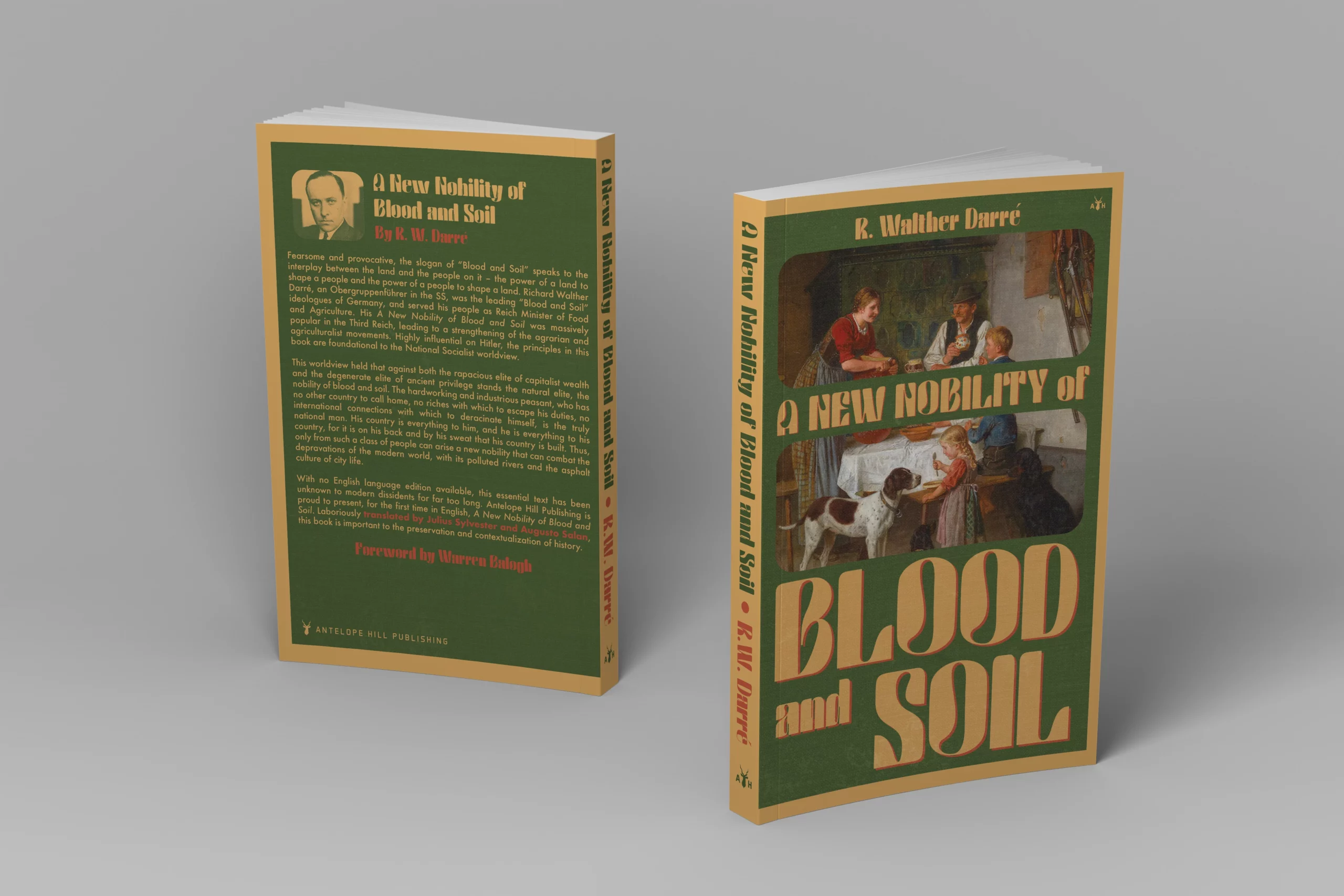
Purchase the book at Antelope Hill. Use code: AMMAN for 10% off at checkout.
ATTENTION READER:
American Mantle exists for the renewal of godliness and righteous power in America. We often go where others rarely dare, directly addressing taboos on faith, ethics, politics, and history.
We are Americans by blood and soil. Our own forefathers conquered and cultivated our homeland, and through great faith, bold strategy, and statesmanship secured the blessings of liberty to themselves and their posterity. We are their posterity, and we resolve to follow them. Join us in this mission.
Donate now to support us.