Holocaustianity, Part 6: Baptizing Liberalism in Church and Education
Governmental discipleship has shifted our perception of our own faith in the postwar decades.

The Church’s postwar shift away from historic Christian understandings of political and social issues and toward a new, pluralistic order often relied on a form of trajectory hermeneutics, an approach stemming from abolitionist and feminist “theology” that imagines a progressive redemptive movement in Scripture. In practice, this interprets God’s plan as heading toward post-Enlightenment ethical ideals on moral and political questions, extending interpretation far beyond the text in order to baptize modern applications like ethnic and sexual egalitarianism. For example, conservative evangelist Billy Graham endorsed a form of this thinking in 1960, stating, “The whole trend of scriptural teaching is toward racial understanding,” urging that the ancestral division of Jim Crow must go, affirming broader social-revolutionary changes inspired by Enlightenment principles syncretized with Scripture through progressive hermeneutics.
Facing a cultural avalanche of Holocaust narratives, Nazi comparisons, and global anti-racism mandates, modern interpreters turned away from historical teachings on ancestral boundaries and hierarchies. Instead, they aligned with the world’s “enlightened” morality, condemning our Christian forefathers for the man-made “sins” of racism and ancestral division and overreaching Scripture’s prescriptions to promote a multicultural ethos that erases the protections of ancestral patriae under the pretense of Christian harmony.
Progressive Theology in “Conservative” Churches
The religious-political use of modern linguistic innovations—“racism,” “antisemitism,” “xenophobia,” and an ever-expanding list of other so-called “phobias”—represented a postwar continuation of Marxism’s long march through the institutions, an evolution on early Bolshevik strategies in which Jewish figures played prominent roles in places like Russia and Germany. Both Bolshevik and post-Bolshevik efforts targeted traditional Christian social structures and institutions such as the church and the family, and the accusation of “antisemitism” was frequently present in twentieth-century Communist propaganda and used against Europeans who resisted. After World War II, this long march continued, not only through communist espionage like that of Julius and Ethel Rosenberg, American Jews who transmitted atomic secrets to the Soviet Union in 1951, but also through the Frankfurt School thinkers, many of them leftist Jews who had fled Hitler’s anti-Bolshevik Germany and consolidated in friendlier Allied realms to advance cultural critiques that would permeate U.S. academia by the 1950s-1960s, fostering neo-Marxist and anti-nationalist sentiments.
Over time, these leftist ideas slithered into Christian seminaries, promoting progressive hermeneutics that reframed Scripture’s clear doctrines in order to condemn nationalism and racism as “sins” while endorsing pluralism and multiculturalism as the grand telos of biblical reconciliation—later seen in modern “diversity statements” from purportedly conservative Christian institutions like LeTourneau University that bend Scripture toward “diversity” and “inclusion” initiatives in order to—in their words—“break the shackles [of] racism.”
This postwar imposition did not stop at the boundary of ethnic mixing, but extended into a dogma of universal pluralism which eroded even the particular faith of our people by imposing inter-religious coexistence by supreme fiat.
As we have seen with a few examples from Race War in High School, the postwar abandonment of filial piety toward one’s God-given patria not only faithlessly erases divine divisions, but also gravely harms our children. Our faithless cowardice, fearful of wicked accusations of the false “sin” of racism, has exposed American children to bodily harm at the hands of foreign ethnic groups whose propensity for criminal violence far surpasses that of our native stock. This postwar imposition of multiculturalism did not end at the promotion of racial diversity, but extended into a dogma of universal tolerance and coexistence. Not content to stop at forcible ethnic integration, the purveyors of postwar pluralism subsequently deinstitutionalized the historic faith of our Christian people by enforcing interfaith egalitarianism through authoritative decree, demoting Christ to one option among many gods, gravely harming the eternal souls of American schoolchildren, now catechized into doctrines of universal diversity by the enlightened priests of Holocaustianity.
Public Education’s Protestant History and the Postwar Purge
The deliberate subversion of American Christianity unfolded through a calculated, stepwise assault, beginning not in the 1960s—as many Christians assume—but in the directly postwar years, when the forces of pluralism first targeted the nation’s ethnic foundations before dismantling its religious core.
This process commenced with the “denazifying” agenda of the postwar era, which imposed a moral imperative to dissolve the particularity of Western society, starting with ancestry and race. Through forcible integration and multiethnic migration, America betrayed her founding Anglo-Saxon stock, compelling her children into a multiracial order within the public schools—once bastions of a White Protestant ethos. Yet, one cannot champion ethnic pluralism on one hand while preserving religious particularism on the other: to shatter God’s creational order is to undermine his spiritual order. As Scripture reveals in the Great Commission, Christ commands us to disciple “nations”—ethnos—each into particular obedience to him. This discipleship varies by group, as seen in Paul’s sharp rebuke of the Cretans to keep them sound in the faith (Titus 1:12-13), or his chiding of the Galatians for their Judaizing gullibility (Galatians 3:1). Even in the Old Testament, God’s prophetic calls to repentance were tailored to each people group, as with Nineveh’s collective turning from sin in Jonah 3 under God’s prophetic warning. Since God is unchanging (Malachi 3:6), we cannot expect faithful discipleship amid our modern imposition of multiethnic chaos, which cuts off the familial bonds of natural piety that once enabled entire peoples—like ancient Nineveh or the medieval kingdoms of Christendom—to repent and thrive as unified kin under Christ. We betray our Savior’s Commission to disciple every nation when we advance Satan’s scheme to shatter the fatherly bonds and filial ties of nationhood ordained by our Creator as sacred links that enable collective repentance.
Thus, it was no coincidence that Satan’s onslaught against ethnic particularism in the 1950s paved the way for his siege on religious particularism in the 1960s. By attacking America’s ancestral ontological identity, the pluralist forces severed our nation from its ethno-religious foundations, priming American society to fall to secular assault—a diabolical sequence we must faithfully confront if we are ever going to reclaim America’s Christian heritage.
As we witnessed in more recent memory after Obergefell v. Hodges, one Supreme Court decision has the instructive capacity to rapidly catechize an entire nation into tolerating and embracing gay “marriage” as “the law of the land,” despite earlier widespread popular resistance. Modern Christians must therefore acknowledge that discipleship under Christ’s all-encompassing earthly authority requires Christian magistrates training their nation through godly laws and customs. Just as a father leads his family in the faith, our early American forbears understood this paternal role of government in shaping its subjects, particularly in the realm of public education. As Anglo-Saxon Protestants, our forefathers established public education and built America’s great universities for the purpose of furthering the gospel of Jesus Christ, not the demonic doctrine of diversity.
Historically, the Protestant roots of American public education are undeniable. The Old Deluder Satan Act, enacted into law by Massachusetts Puritans in 1647, mandated public schools to counter Satan’s deception through Scriptural literacy, while the Northwest Ordinance in 1787 declared, “Religion, morality, and knowledge being necessary to good government and the happiness of mankind, schools and the means of education shall forever be encouraged,” rooting public education in America’s Protestant roots.
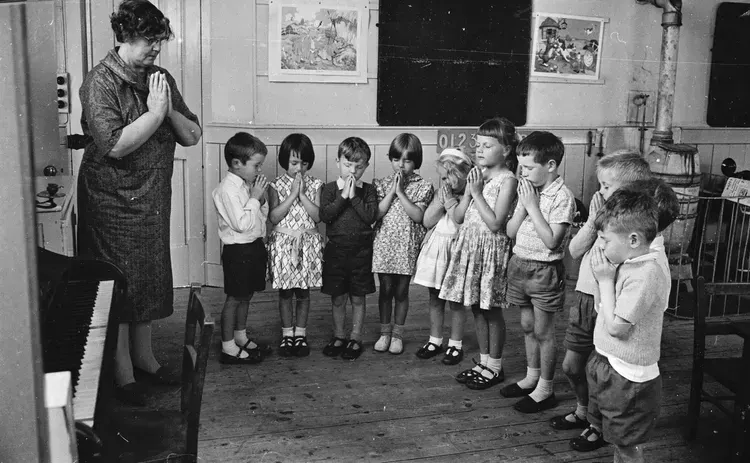
From the colonial era onward, these foundations manifested in daily practices that were explicitly Protestant, such as opening school days with oral prayers, singing hymns, and conducting Bible readings from the King James Version—a Protestant translation commissioned by the King of England (sorry, anti-sacralists!) that profoundly shaped our American idioms, literature, and cultural heritage. Early textbooks like the New England Primer, first published around 1690 and used widely for over a century, combined alphabet lessons with religious maxims, moral verses drawn from the Bible, and Protestant catechisms, such as the Westminster Shorter Catechism or John Cotton’s “Spiritual Milk for Boston Babes,” which taught Protestant doctrines of sin, salvation, and submission to divine authority.
By the 19th century, ecumenical reformers like Horace Mann were advocating for “nondenominational” education that was, in practice, still steeped in Protestantism. Thus, public schools continued these traditions, incorporating McGuffey Readers filled with biblical stories and moral exhortations to promote Protestant values. This pervasive Protestantism met conflict in more diverse areas, as seen in the 1844 Philadelphia Bible Riots, where native-born Protestants clashed with Irish Catholic immigrants amid rising ethnic and religious diversity, with a central disagreement revolving around the role of religion in public schooling, particularly the use of the Protestant King James Bible versus Catholic demands for exemptions or the use of their Douay-Rheims version. This dispute echoed broader tensions over the problems caused by immigration, leading to early questions about religious pluralism and the soul of American public institutions amid rapid urbanization and demographic change.
Acknowledging the broader WASP dominance in American society, Catholic parochial schools emerged in the 19th century as alternatives to America’s Protestant-dominated public education system, allowing newly arriving Catholics to preserve their own faith traditions. Ironically, this early establishment gave Catholics a significant lead in the private school arena, underscoring how America’s public school system was, in large part, firmly grounded in Protestantism, prompting private alternatives to emerge before Protestants themselves would suddenly need them in response to the postwar secular takeover of America’s public schools. Even during World War II, public schools still continued these Protestant practices, with daily prayers, Bible readings, and hymns reinforcing moral and patriotic ideals amid wartime calls for national unity, though tensions persisted in diverse urban centers where growing Catholic and Jewish communities challenged Protestant public school exercises.
After the war, however, the secularizing influence of the modern pluralistic creed gained significant momentum. The rising narrative of Holocaust atrocities armed American Jews with a searing emblem of victimhood, empowering them to exact sweeping concessions from a yielding and largely still-Christian national conscience. Yet, recall that in the first century, Paul warned in 1 Thessalonians 2:16 that the Jews, by “forbidding us to speak to the Gentiles that they might be saved,” did everything in their power to obstruct the gospel. Paul’s caution proved prophetic in the postwar era as secular forces, often led by anti-Christian Jews, dismantled Protestant public education in America—stripping the task of discipleship from the left hand of Christ. Wielding the psychological potency of anti-Nazi propaganda to denounce all forms of ethnic particularism, the secular priests of pluralism pursued decisive political changes to demolish America’s Protestant educational foundations. Foremost among them was Leo Pfeffer, a Jewish lawyer aligned with the ACLU and American Jewish Congress, backed by the outsized sway of organizations like the American Jewish Committee and Synagogue Council of America.
In 1962, Pfeffer filed influential amicus briefs for the American Jewish Congress in Engel v. Vitale—initiated by lead plaintiff Steven I. Engel, a Jewish parent—securing a Supreme Court ban on school-sponsored prayer. This was followed by Pfeffer’s similar involvement in Abington School District v. Schempp in 1963, where the Court outlawed mandatory Bible readings and the Lord’s Prayer, with Justice Arthur Goldberg (also Jewish) emphasizing America’s need for neutrality in his concurrence amid growing diversity. These rulings, propelled by a multicultural coalition in which Jewish groups and individuals played a pivotal role in advocating for strict church-state separation to “protect religious minorities” from Protestant dominance, aligned the postwar pluralist mandate to appease diverse Jewish, secular, and multi-faith sensitivities. The resulting change was monumental, stripping public schools of their Protestant moorings, and replacing them with a secular mandate that subordinates obedience to Christ to the pluralistic religion disavowing all gods and masters. As a result, today’s public schools serve as training grounds not for the faith of our White Protestant forebears, but for the anti-faith of secular Jews and others in the “global community” soon to be welcomed onto American shores with anti-particularistic zeal. Since nature abhors a vacuum, a new, Christless faith has rushed into American public schools in the postwar decades. Today, schools train up not American Christian children as our forebears envisioned, but “global citizens,” baptized into a religion of pluralism that catechizes children in diversity, equity, inclusion, antiracism, anti-discrimination, sexual liberation, and sinful tolerance—worldly doctrines echoing Babel’s unified rebellion and Babylon’s seductive apostasy (Genesis 11, Revelation 17). Pursued by Jewish and other Christ-dishonoring interests and enforced by anti-democratic federal fiat, this top-down catechesis has swayed even modern Christian leaders to capitulate to a number of the religion’s tenets of pluralism and so-called “secular neutrality,” distancing American Christians from the faith and filial piety of America’s Anglo-Saxon Protestant founding stock.
Precipitating this secular onslaught was the 1961 Eichmann trial in Jerusalem, whose extensive global media coverage—including televised survivor testimonies broadcast into American homes for the first time—reignited wrenching Holocaust narratives in the public consciousness, strategically muting traditional Christian resistance to Jewish meddling in Christian society. By associating any form of religious or ethnic exclusion with the horrors of Nazi antisemitism, the Holocaust narrative’s potency impelled the West to deliberately distance itself from national particularism, fostering a climate where Protestant defenses against pluralistic encroachments were branded as morally equivalent to genocide and thus rendered indefensible.
As a result, even among conservative, “Bible believing” Christians whose faith requires them to profess submission to Christ as “King Of Kings And Lord Of Lords” (Revelation 19:16), wielding “all authority in heaven and on earth” (Matthew 28:18), the rise of Holocaustianity, the ascendant religion of postwar pluralism, exerted moral and political dominion over the American Church. Thus, Holocaustianity supplanted Christianity in the West, overthrowing Christ’s imperative to disciple all nations, “teaching them to observe all things whatsoever I have commanded” with humanistic edicts to “protect religious minorities” and “uphold neutrality” in the public sphere, as decreed by the U.S. Supreme Court, reducing Christ to one god among many, and rendering Christianity a mere private faith, incompatible with public education.
Dear Christians, consider how this governmental discipleship has shifted our perception of our own faith in the postwar decades. Is it any wonder that increasingly antinomian believers reimagine Christ not as sovereign Lord and King over their lives and governments, but as a cozy “boyfriend Jesus” affirming our lawless egalitarian pluralism with tolerance, acceptance, and demonic notions of “love”?
“They profess that they know God; but in works they deny him, being abominable, and disobedient, and unto every good work reprobate.”
(Titus 1:16)
Insofar as we have ceded our posterity’s discipleship to Satan and his children, can we expect any less? Defying our founding fathers’ vision for Protestant public education for their nation, American schools have instead discipled our people into a new and different faith, “a happy-clappy faith, where everybody’s nice, everybody’s sweet,” and where “the only sin that’s still left is ‘Nazi’ sin,” as Bishop Williamson opined. Overthrowing Christ’s all-encompassing authority, subordinating his reign to the dictates of a postwar empire hypocritically proclaiming itself “one nation under God,” and groveling before antichrist atheists, Jews, and adherents of false religions in the patria of our Protestant forebears, the Supreme Court imposed ethno-religious pluralism on American schoolchildren, molding modern believers into a paralyzed position of pluralistic neutrality and privatized piety. Today, even the most “devout” conservative Christians cower at any assertion of Christian Nationalism, viewing it utterly contrary to their postwar catechesis into godless pluralism, even as they pay through the nose to send their children to private schools to escape the debauched public school system funded by their tax dollars. Among American believers, Christ’s Great Commission has been reduced to a “missions” budget for overseas excursions, while American schoolchildren are discipled into dogmas of diversity in the public schools once founded on Anglo-Saxon Protestant piety.
ATTENTION READER:
American Mantle exists for the renewal of godliness and righteous power in America. We often go where others rarely dare, directly addressing taboos on faith, ethics, politics, and history.
We are Americans by blood and soil. Our own forefathers conquered and cultivated our homeland, and through great faith, bold strategy, and statesmanship secured the blessings of liberty to themselves and their posterity. We are their posterity, and we resolve to follow them. Join us in this mission.
Donate now to support us.