Great Americans: Robert Lewis Dabney—Hereditarian Prophet of Logic and Fire
An example to all Christians today, especially ministers.
Introduction
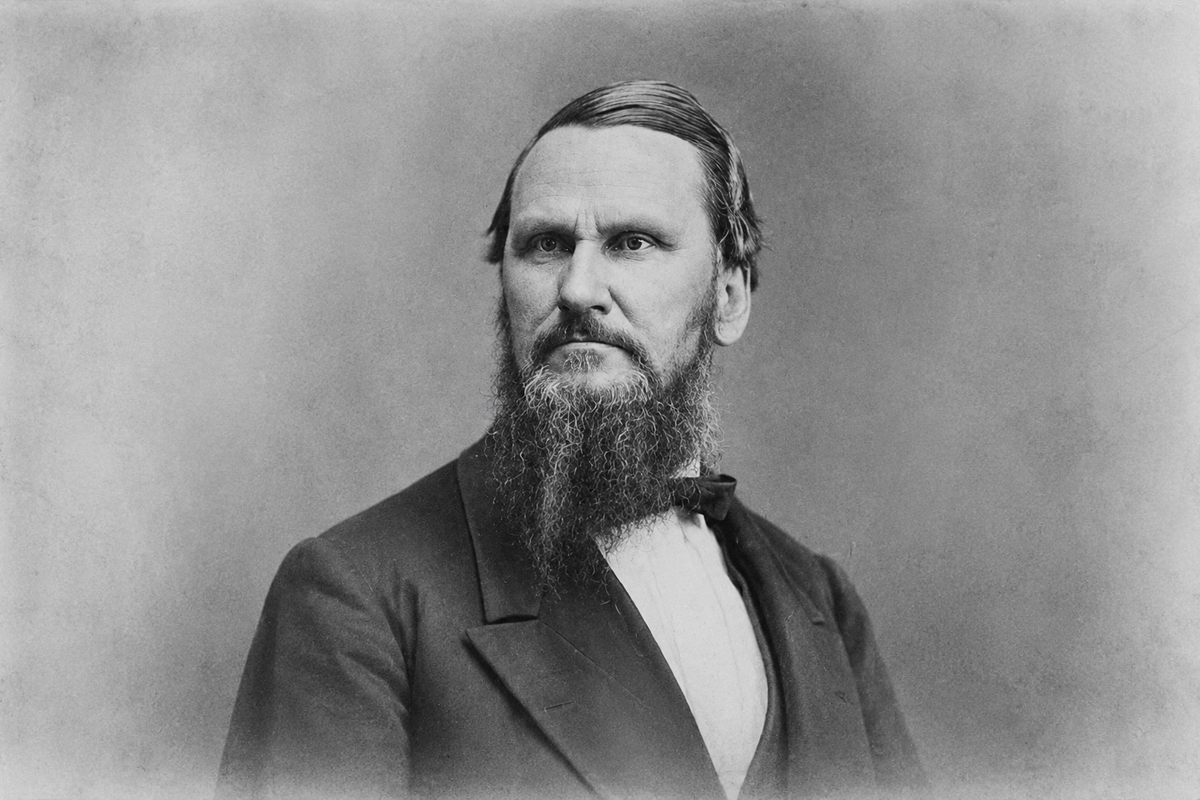
God has blessed the United States of America with many godly men who helped shape the political and religious life of the nation. Regarding her religious life, I can think of no greater influence than Robert Lewis Dabney. Dr. Joseph Pipa, a current minister in the Presbyterian Church of America (PCA), wrote: “R. L. Dabney was one of the nineteenth century’s greatest theologians, in fact one of the top Reformed theologians of all time.”1 And Dr. Douglas Kelly, also a current minister in the PCA, compared Dabney with other great American theologians such as Thornwell, Shedd, Hodge, Palmer and Archibald Alexander and concluded, “…the events of this rapidly concluding twentieth century have shown that Dabney excels them all.”2
What made this man so great and why is he so poorly known today? I hope to answer this question in this article and also to provide an enjoyable summary of this man’s life. May God use this article to instill the virtues of this man in God’s people today and ignite a resurgence of popularity in his writings. I will divide my article into 5 parts.
Part 1 – Dabney’s Family and Early Life
Robert Lewis Dabney was born on March 5, 1820 to Charles Dabney and Elizabeth Price in Louisa County, Virginia. He was the fourth of six children: Charles, Mary, Ann Eliza, George, and Betty being his siblings.3 His ancestry was of English, Scotch and Huguenot blood. There were three strands of the Dabney name that came to America in the early years of the nation, and his specific ancestor was John Dabney who landed at Virginia in 1715. It is commonly believed that his family name was originally “D’Aubigne” in the French tongue.
His father, Charles, served in the War of 1812 and later became a Colonel in the Virginia militia. He owned a prominent amount of land and slaves and later served on the state legislature as well as being an elder in the local Presbyterian church. But unfortunately, he died of a violent fever when young Robert was 13 years old. But Charles Dabney left his children with a strong Christian example.
Dabney described his mother, Elizabeth, as “a Virginia Matron” and his biographer said, “She was first of all a Christian matron, whose hidden devotional life was beautifully reflected in her daily walk and conversation…she was also a careful, industrious, and successful housekeeper…fit consort for her husband, and a worthy mother to all her children.”4
Dabney later wrote of his parents’ religious life in 1885 as follows:
“When I recall what the position of Christian meant, as occupied, for instance, by my parents, it seems to me as if that type of Christianity must have been in another sphere, and before the fall of man almost! With what careful seriousness, self-examination and prayer did they take their religious vows! How regular, deliberate and solemn were family prayers! How did the scriptural instruction of us children take the precedence of all the day, and of all other duties, lessons and amusements! How sacredly was the Sabbath improved!”5
One story that shows the formation of his zealous and determined character involved doing work around the plantation with his father as a young boy. Young Dabney proposed to carry a large stack of wood to the house but his father protested that it was too heavy. Young Dabney continued anyway. But after becoming too tired under the load of wood, he dropped it. Then his father rebuked him saying, “You undertook to carry it home, and now you must do what you undertook.”6 What was this lesson that young Dabney learned? Finish what you start. And this determination of mind was followed throughout his life.
For young Dabney, “Though his father was the leading man of his country, the boy grew up in a cottage house, smaller rather than larger than the house of the average gentleman of his country. He grew up uncorrupted by wealth and addicted to industry, even to manual labor whenever there was suitable occasion.”7
As for his education, young Dabney was trained classically, being steeped in Latin and Greek. His first teacher was his older brother, Charles, before he advanced on to other tutors—mainly ministers in the area. At the age of thirteen, he rode his colt seven miles one day a week to receive further instruction in algebra. His biographer noted, “He had, prior to entering college, accomplished more work in the classics than is now required of a candidate for the degree of Bachelor of Arts.”8
But most importantly, in these earlier years, his clear and powerful mind was being formed. “He could never have done the great work of his mature years without both industry and economy, and it was well, accordingly, that he should have these qualities developed in his boyhood days.”9
For college, he first attended Hampden-Sydney in 1836 at the age of sixteen, but later attended the University of Virginia from 1839-1842. He paid his own way through the University of Virginia by working and living over 5 miles away and riding on horseback daily.10 This daily exercise improved his health and strengthened his body.
Regarding his conversion to Christ, it is likely that, growing up in a Christian home, he was converted at an early age. However, one biographer notes that he did have deep religious impressions during his first year at Hampden-Sydney around 1836-1837 due to a revival that had visited the school. Then, one Sunday in 1837, young Robert was admitted into communicant membership of Providence Presbyterian Church in Louisa County.11
Regarding his call to the ministry, his biographer reports that he made up his mind to preach the gospel after the encouragement of his mother’s pastor, Rev. James Wharey. But after finishing his undergraduate degree, he postponed his entry into seminary in order to pay off debts, provide for his widowed mother, help his younger sister Betty in her education, and stock up for the future.12 The reader must keep in mind that his father had died and he was the primary male around the homestead. For this reason, Dabney felt an obligation to help his mother before leaving her with the land and their slaves. During this intermediate time, he saved money and made sure things were well at home. He taught a classical school in his mother’s house and wrote for his sister Betty an entire Latin grammar.13
Eventually, in 1844, he began his studies at Union Seminary after first being taken under care of his Presbytery. It is noteworthy to include a letter of recommendation by the venerable William S. Plummer which Dabney took in hand upon arrival at seminary:
“Richmond, Virginia., November 7, 1844.
To the Faculty of Union Seminary.
Dear Brethren: Although the bearer, Mr. Robert Dabney, has been introduced to all of you, yet you may not remember him. At all events, I take great pleasure in saying to you that he has my entire confidence as a gentleman, Christian and scholar. I have known him for some time, and have always highly esteemed him and all his family.
I hope you will give him your confidence from the first. He is a candidate for the ministry under the care of West Hanover Presbytery.
I trust his time at the Seminary will be spent pleasantly.
Accept my kind regards for yourselves and your families.
Very truly yours,
William S. Plummer."
He immediately set himself to his task as a seminary student. His biographer reports, “He was remarkable amongst his fellow-students, not for the time he pored over his books, but for the intensity of effort with which he applied himself while at it.”15 And all of this despite having periods of poor health (dysentery) and weak eyes. By in 1846, he was licensed to preach and, in 1847, he took a call to Tinkling Springs Presbyterian Church in Virginia.16 He served at this church as their pastor for only a few years before being called to the seminary as a professor. Later in life, he said that all he ever wanted to do was be a pastor of a church in Virginia.17 He greatly enjoyed pastoring the people and preaching the gospel to them. But the Lord had other plans for this gifted man of which we will speak more of in subsequent parts of this article.
In 1848, at the age of 28 years old, he married Miss Lavinia Morrison. She was 24 years old, with sandy blond hair, and of “puritan manufacture.”18 He described their courtship and marriage in this way:
“Mine was very nearly a case of ‘love at first sight’, but I have never thought this unreason or rashness, as I had heard much of her character from her admirers, whom I knew to be young men of good sense and truth…it only remained for me to see if her person and manners would suit my notion. I soon decided this. Then began the first and last love affair of my life. We were married on the 28th of March, 1848.”19
He remained warmly affectionate toward her all his life as demonstrated by this note in a letter to her while attending the 1856 General Assembly in New York:
“I have spent today in shopping and sight-seeing. But there is a drawback on all my pleasure: you are not with me to share it. Sometimes I think that if you could not come consistently with duty (as I know you could not), I ought not to have consented to come and see or enjoy anything without you, and that it is selfish to do so. But I know your love will not judge thus. I see a great many things which are extremely interesting; but I am not happy, except for a few minutes when I forget myself.”20
God blessed their union with six boys. However, three would die of diphtheria in their youth: Robert and James in 1855 and Thomas in 1862. The first two died within a month of each other, which caused enormous grief to Dabney. Yet, through this experience, he was later more equipped to comfort others in similar situations and was made more zealous for evangelism—especially toward his elder and unconverted brother.21
His three other boys would all become successful men. His biographer writes,
“Dr. Charles William Dabney being the eminently successful President of the University of Tennessee, Mr. Samuel Brown Dabney enjoying the fruits of a large law practice in Victoria, Texas, and Mr. Lewis Meriweather Dabney holding already a position of great promise in Dallas, Texas.”22
In his last years, he loved his two granddaughters with great affection and wrote letters for them to read after his death. The following letter is well worth quoting in full, for it shows his love for Christ, and his tender heart for his own family. This letter is especially useful to rebuke the commonly held critique of Dabney as a “grumpy old Confederate.”
"To my dear sons and daughters and their children:
I desire before I leave the world, as my best legacy to my family, my serious, solemn advice, to make choice of God for their God. He has been my father's God, and the God of your mother's predecessors.
I solemnly charge you to make it your first care to seek after peace with God, and being reconciled, to make it your study to please God in all things.
Wait diligently upon the means of grace, attending the worship of God in his house; study his Word, after secret prayer, especially family and the public ordinances.
Beware of the mere form of these duties; but cry to the Lord for communion with him, so that you may worship him in spirit and in truth.
Follow God fully, without turning aside. I have often devoted all of you to God, and there is nothing I have so much at heart as this: that you may indeed be the Lord's; and if you turn aside from this way, I will have this as a witness against you in the day of the Lord.
Be good to your mother, as you would have God's blessing. She will need your comfort. Beware of religion that is most taken up with public matters.
The sum of the gospel is Christ crucified. I commit my body to the dust, hoping and expecting the spirit will in due time quicken my mortal body. My spirit I commit to my Lord Jesus Christ; to him I have entrusted it long ago.
Now, my dear boys, this is my last legacy, that we all meet where there is no more death, sorrow nor sin.
Your devoted father,
R. L. Dabney.
"Be kindly affectionate one to another."
"Remember the Sabbath day to keep it holy."23
We now turn from Dabney’s early and private life, to his more public life as a writer, patriot, and professor.
Part 2 – Dabney as a Pastor and Preacher
Dabney was the pastor of Tinkling Springs Presbyterian Church in Virginia from July of 1847 to August of 1853. Then, in 1853, he was called by the seminary and his Presbytery to be the professor of Ecclesiastical History and Polity at Union Seminary in Virginia. But, even as a professor, he spent his sabbaths providing pulpit supply for various churches in his area. In 1858, he and Dr. B.M. Smith took charge of the College Church in Hampden-Sydney as co-pastors. He stayed in this position until 1875 when he resigned from this charge for health reasons to focus on his role as a teacher and professor. In this section, I will cover his life as a pastor and preacher.
The men that knew Dabney well described his preaching as intellectual, yet fervent. As a preacher, he was not as known for his power and pathos like other men of his time (namely Palmer and Girardeau). Yet, nonetheless, God used him mightily. It is probably best to describe him as a “preacher for preachers.”24 He convinced the mind with biblical logic and rebuked error.
Rev. W.T. Price described his early preaching saying:
“Dr. Dabney’s preaching was pungent and searching, and, in instances known to myself and others that I have heard of, the searching of heart and a sense of unworthiness have been such as to overwhelm pure-hearted, conscientious young seminarians to such an extent that they would not be equal to their student duties for days, and it sometimes looked as if they might give up in despairing sense of unfitness…”25
Later in his life, Dr. Broadus (who was a well-known and respected Baptist preacher and teacher), said regarding Dabney’s sermon “The World White to the Harvest” that it was “one of the most powerful sermons with which he was acquainted.”26 Much could be said about his preaching, especially during the revival that took place in the Army of Northern Virginia. He was a man that was committed to the gospel and experimental religion. Other than a few occasional sermons regarding the War, he focused on the spiritual truths of Scripture and not politics. He wanted his people to know Christ and him crucified.
I consider his book “Evangelical Eloquence” to be one of the best books on preaching that I have ever read. In it he provides a healthy mixture of classical learning and biblical instruction. He especially emphasizes the need to have one point in the sermon, and for the preacher to be a holy man without any “artifice” in his presentation.
After his first sermon in 1845, he wrote, “I am convinced by my first trial that I can never read sermons to my people in any comfort. Extempore preaching is the thing for me…It is much more important that sinners should be excited to listen to the truth than that I should have the reputation of a pretty writer.”27 Later, however, he would accustom himself with various ways of preaching, both with and without notes and even a full manuscript.28
As a worship leader of the congregation, his liturgy would be best described in today’s standards as “simple.” He strictly objected to the use of instrumental music in the worship of God. In a letter to his wife in 1856 he wrote, “The assembly adjourned very late last night…we…sang the hymn–Come, Christian brethren, e’er we part–to the Old Hundredth (making, to my ear, better music than all the organs in the world)...”29 He loved, as a man of his time, the man-made hymns of the church, but he also held the Psalms of David dear to him.30
In the worship of God, his focus was on the preaching. I highly doubt he had liturgical readings and responses as is common in today’s Presbyterian churches. During the War, he would mount a stump, announce the hymn, pray, read and preach. Communion was observed less frequently as today, and communion seasons were common, according to the old Scottish tradition.
As a pastor, Dabney loved his people and was faithful to them despite having duties in the seminary. The death of his three sons touched his heart and gave him a compassionate spirit towards the weak and mourning. It also inflamed his spirit to win souls and persuade men to close with Christ. He wrote in 1855, after the death of his firstborn:
“I have learned rapidly in the school of anguish this week, and am many years older than I was a few days ago. It is not so much that I could not give my darling up, so far as self was concerned, but that I saw him suffer such pangs, and then fall under the grasp of the cruel destroyer, while I was impotent for his help. Ah!…To see my dear little one thus ravaged, crushed and destroyed, turning his beautiful liquid eyes to me and his weeping mother for help, after his gentle voice was obstructed, and to feel myself as helpless as he to give any aid—this tears my heart with anguish.”31
As I mentioned earlier, he hoped to be a preacher and pastor for his entire life and was not aspiring to be the great doctor of the church that he would later become. However, his intellectual capability and gifts were well known by the broader church. He was awarded an honorary doctorate at the age of 33 and was elected as a professor in 1853 for Union Seminary. His call from Tinkling Springs church to the professorship at the seminary was submitted to his Presbytery for approval. He sought the will of the church, and the Presbytery overwhelming encouraged him in this new field of ministry.
He would stay at Union Seminary for 30 years. His biographer writes regarding this transition to the professorship, “There he was destined, by his writings, to bring the philosophical and theological world into debt to God for him; and, while residing there, he was to figure as a patriot and soldier.”32
During these early years of his ministry, he wrote many books and articles. Yet, I must hasten on to Dabney’s life during the War Between the States and the issues of race and slavery for which he is “infamously” known.
Part 3 – Dabney and the War
Dabney first fought against the abolitionist with his pen in the years leading up to the War. Yet, the abolitionists won the propaganda battle and would have their war. Thus, although reluctant for brothers to war against each other, he joined the fray first as a chaplain for four months for the 18th Virginia regiment. During this time, he participated in the revival services and conducted prayer meetings and witnessed many battles. Yet, General Jackson, who was well acquainted with Dabney already, was eager to enlist him as his chief of staff. In January of 1862, Stonewall wrote to Dabney, “…I have had a strong desire to have you with me ever since I knew you.”33 Jackson assured him that he would have the opportunity to preach on the Sabbath, but wanted Dabney’s skills as an adjutant (or chief of staff). In this role, he would be responsible for communicating orders and making sure the intent of the General was understood and received by subordinate field commanders in a timely fashion. Dabney was given a commission as a Major and would spend much time in this role in close contact with Stonewall Jackson. Later Stonewall was known for saying that Dabney’s was “the most efficient officer” that he knew.34 However, his time as a soldier was cut short due to severe illness. In July of 1862, Dabney returned to the rear in Virginia and recovered while still writing and preaching.
Because of Dabney’s modesty, there is a less known story regarding Dabney as a combat leader. It is true that he was not regularly wielding his saber in battle, yet he did play an important role at one point in one specific battle. This story shows that Dabney truly did fight for his country, not only with his pen, but also with his sword.
The event occurred during the Battle of Port Republic in June of 1862, and Dabney reports his actions in a letter written in 1891 which is included as an appendix in his biography. The actions of Dabney that day were not known until much later because, being an adjutant and not having a field command, he did not think it important to report the actions in Jackson’s official records.
Essentially the story goes that Jackson’s supply trains were in grave danger by Yankee cavalry. In fact, Jackson himself and his staff were put in imminent threat and, while Dabney was preparing a sermon for that Sabbath, he was alerted to the imminent threat while in his tent. After being notified of the situation, he took action as if a field commander. He familiarized himself with the dangerous situation and then ordered a group of fifteen rifleman (commanded by a captain) to defend a specific location and fire at the confirmed enemy in the town. He then gathered a group of twenty-five cavalrymen to support in the engagement. The enemy fired upon them but without success and the Yankees eventually yielded to the spontaneous and rigid defense of this haphazard unit of Confederate troops. Although he was not wounded, shells landed near Dabney. Yet he held his ground and directed the main two units in the battle. He later wrote about this engagement saying,
“You are right in supposing I was the staff officer who saved the baggage train. In my Life of Jackson, I did not name myself or go into details, because I thought it would be in bad taste…Hence nothing appears of it in Jackson’s official report, compiled months afterwards from those of the field officers; but with less than seventy men, all told, I saved his army that time, for had that ammunition train been blown up by Carroll we should have gone up the spout.”35
Jackson would later die at the Battle of Chancellorsville in May of 1863. Dabney—in order to gain support in Europe for the Confederacy—wrote a biography of General Jackson. The Life and Campaigns of Stonewall Jackson is not only considered by many to be his most popular and greatest literary achievement of his life, but it also provided for posterity a political defense of the South regarding their righteous cause. Chapter 5 “Secession” serves as a great summary of why the South fought the war and why they were constitutionally and politically right to secede from the Union and defend their homeland from Northern invasion.
Regarding the issue of slavery, Dabney wrote the definitive defense of Southern slavery in his book A Defense of Virginia published after the war in 1867. Today, he is unfortunately best known for being a so-called “racist.” Yet, the reasons for why he is despised today are the very reasons why he should be loved by all sincere Christians. In this book he provides the theological and biblical defense, not only for slavery as an idea, but specifically for slavery in the South. He did condemn the sinful circumstances of the slave trade yet defended the principle itself of buying and selling slaves. He explained the historical significance of the slave trade and why it did not necessitate the condemnation of slavery in the Southern states. He exposed the hypocrisy of the North by showing that they used this “fake” humanitarian concern as a cover to rob the South of her wealth and maintain political and monetary control over the whole nation. He described the war as the great crime of the century and concluded his book by saying, “…let the arrogant and successful wrongdoers flout our defence with disdain: we will meet them with it again, when it will be heard; in the day of their calamity, in the pages of impartial history, and in the Day of Judgment.”36
Perhaps the most infamous quote in all that Dabney ever wrote is contained in this book. I will quote it below and give a brief defense. It involved him referring to Blacks as that “vile stream from the fens of Africa.” He said,
“But while we believe that 'God made of one blood all nations of men to dwell under the whole heavens,' we know that the African has become, according to a well-known law of natural history, by the manifold influences of the ages, a different, fixed species of the race, separated from the White man by traits bodily, mental and moral, almost as rigid and permanent as those of genus. Hence the offspring of an amalgamation must be a hybrid race, stamped with all the feebleness of the hybrid, and incapable of the career of civilization and glory as an independent race. And this apparently is the destiny which our conquerors have in view. If indeed they can mix the blood of the heroes of Manassas with this vile stream from the fens of Africa, then they will never again have occasion to tremble before the righteous resistance of Virginian freemen; but will have a race supple and vile enough to fill that position of political subjection, which they desire to fix on the South.”37
Anyone who is not poisoned by the egalitarianism of our day and willfully blind to the general behavior of Blacks in America cannot honestly disagree with this controversial statement. By God’s appointment and sovereign will, the African race, generally speaking, is a “vile stream.” Dabney wrote these words not as a bitter and angry hater, but as a godly and honest man.38
After the War, Dabney had a desire to immigrate.39 He said, “…I fear that the only way to save Virginia is to take her out of Virginia.”40 He believed that his Southern people would be forced by their conquerors to eventually amalgamate with the Black population and that it would thus become like Mexico—a sparse land of mulattos. His biographer critiques him for losing sight of Christ and his sovereignty during this time of his life.
However, if it had not been for his (and other Southern leaders) continued defense against racial egalitarianism and of racial segregation, his fears would have become reality. This fear, however, has become reality in our current day. The White race is being destroyed, not only in America but also in Europe, by replacement and amalgamation. Thus, I find that his biographer was too harsh. There are times of sadness and fear, just as there are times of joy and hope. His fear and deep concern for his own people helped provide the “New South” with the biblical basis and firm will to resist the poisonous ideas of their Northern invaders. Thus, for many decades following the war, the South maintained their race and culture despite having to deal with the struggles and difficulties associated with freeing the African slaves and granting them equal civil rights.
Part 4 – Dabney in his Elder Years
After the War and despite the issues related to it and its aftermath, Dabney’s main work and focus was as a minister of the gospel. Called to the function of a Professor, he continued teaching at Union Seminary as the Chair of Systematic and Polemic Theology and was her most respected faculty member during his tenure there. He would eventually move to Texas in 1883 when he was elected as the Chair of Mental and Moral Philosophy in the University of Texas.
His esteem as a thinker and writer was so high that, before the War he was offered a position at Princeton Seminary. Dr. Charles Hodge wrote to him in March of 1860, “Now, my dear sir, would that I could sit down by your side, or even at your feet, stranger as I am, and beg you, with many prayers and supplications, to consent, should God see fit to call you to come and help us in our great sorrow and need.”41
Yet, Dabney refused to take the call to Princeton, partly because he felt his own native State held a right to his labor, and also because, a move to Princeton at that time would cause him to break up his family (i.e. his slaves). He wrote to Hodge in April of 1860 saying,
“…I might attach some weight to the considerations that in removing to Princeton I must finally rupture the ties of affection and dependence which bind me to my servants, must see my Black household scattered abroad, to be reassembled no more, and must subject my wife to domestic arrangements untried to her.”42
For more information on Dabney’s views on the care of slaves in the South, I direct my reader to appropriate sections of his Defense of Virginia and to a letter he wrote to General Howard regarding the U.S. Freedmen’s Bureau in September of 1865.43 Yet, let it be known that he was a staunch advocate of the spiritual care of the Negroes and often preached to them. He, in designing various churches during his life as an architect, provided not separate churches for the slaves, but large balconies so that they could worship with their masters as members of the same church. He condemned the mistreatment of slaves and desired their salvation and appropriate care. Although his views would be seen as unacceptable today, they would be described by the apostle Paul as “just and equal” (Colossians 4:1). The key to understanding this point is for my reader to strip themselves of all the Marxist propaganda of the current day and to think biblically.
Regardless, Dabney declined this call to Princeton and labored for his own Southern church and specifically to the training of her future pastors. He was beloved by his students and held in high esteem as a doctor in the church. He wrote voluminously and labored incessantly to provide the church with solid orthodox teaching according to the Old School and Calvinist perspective. He used Turretin in his classroom but eventually developed his own Systematic Theology which was approved by him for publication, although it began, in my understanding, as printed syllabi for his students. Banner of Truth has printed three volumes of his original five volumes known as hisDiscussions.He also wrote two books on philosophy: The Sensualistic Philosophy and The Practical Philosophy. He considered the latter book his greatest volume.
Dabney was not only a tireless worker in the Kingdom, but a man of many gifts. He was a not only a preacher, pastor, theologian, churchman, and philosopher, but also a soldier, architect, inventor, gardener, husband, and father.
There are two stories that must be told about his time as a doctor and leader of the Southern church. The first involved his activity as the moderator of the general assembly in Louisville in 1870.
The Northern Presbyterian church sent a delegation of men to the Southern Assembly with intentions of expressing union and peace. He allowed them to speak and forced himself to respond as a moderator with the appearance of neutrality. His friend Dr. Joseph Wilson, knowing how he personally felt about these carpetbaggers, exhorted him, “Dabney, can’t you for once in your life make a speech without saying anything?”He replied,“I shall try.”His biographer noted the result saying, “He was cold, polite, dealt in generalities altogether, and closed without saying anything in particular.”44
However, the Northern delegation did not stop pressuring the Southern assembly but exhorted them to forgive and forget. I will not bother my reader with the details, but the short story is that there arose, during the assembly, some measure of confusion on what to do with these overtures of peace. Men were confused on how to respond because, after all, Christians are supposed to forgive, right?
The Assembly was working late into the night and the matter was unsettled. His friends (including B.M. Palmer) urged Dabney to relinquish his role as moderator and to take part in the debate.
“Dr. Dabney, you must speak. This debate is taking a fatal turn; these men are all entangling and committing themselves on the wrong side.”Dabney whispered back,“No; I am Moderator, and I don’t want to be thought intruding in this debate.”45
He was committed to playing the moderator. Yet, under constant pressure by his friends he eventually yielded and gave what many consider to be his finest speech in the courts of the church, which I will call, “I will never forgive!” I insert below a long but truncated quote from his biographer,
“Dabney was breathing heavily; he was restless and nervous. Green leaned back and said,‘Doctor, have you nothing to say?’ ‘No,’he replied;‘if this body listens to such talk as we have been hearing, they don't want anything from me.’
Mr. Green said,‘We have a right to hear from you, and all are waiting for you to speak." Dr. Green writes,‘He was on his feet in a moment. He began this way:
Mr. Chairman, I feel as if I were talking to people across a river a mile wide. If you are pleased with such speeches as you have been listening to, it is useless for me to express my thoughts. I do not profess to be as good as some people; I hear brethren saying it is time to forgive. Mr. Chairman, I do not forgive. I do not try to forgive. What! Forgive these people, who have invaded our country, burned our cities, destroyed our homes, slain our young men, and spread desolation and ruin over our land! No, I do not forgive them.
But you say, "They have changed their feelings towards us, are kind." And why should they not be kind? Have we ever done anything to make them feel unkind to us? Have we ever harmed or wronged them? They are amiable and peaceful, are they? And is not the gorged tiger amiable and peaceful? When he has filled himself with the calf he has devoured, he lies down in a kind, good humor; but wait till he has digested his meal, and will he not be fierce again? Will he not be a tiger again? They have gorged themselves with everything they could take from us. They have gained everything they tried to get, they have conquered us, they have destroyed us. Why should they not be amiable and kind? Do you believe that the same old tiger nature is not in them? Just wrest from them anything they have taken from us, and see.'
Continues Dr. Green: "In that way, he went on for an hour. I never heard such a [speech]. I was frightened. I believed every word he said, but I thought I had never encountered before such a terrible man."…
Writing of it long afterwards, Dr. Dabney said, "I felt that I must just let myself loose. It was a fight for life or death.”46
This speech directed the assembly away from reconciliation with the North on the grounds of their sin and refusal to repent. Dr. B.M. Palmer later wrote to Dabney, “Our people lack tenacity in resistance…my heart has been with you ever since the Assembly in Louisville….”47
I remind my reader that God does not forgive sinners who do not repent and neither should his people. It is a fake reconciliation that leads to a false religion and fake Christianity. In this incident we see Dabney as the great leader and churchman that he was. Although in later years, his influence on the Southern Church would lessen and he would be seen by some as an embittered old man, yet, his strength of character and ability to think quickly, helped stir the Southern Church from the errors of the North. As a result, the Southern Church remained more orthodox for much longer than the Northern church. Machen’s life teaches us about the eventual and total apostasy of the Northern Presbyterians in the 1920s, but the Southern church would not apostatize fully until the 1970s when the PCA was formed. Why? Because of the rigid defense of the truth by Dabney (and others like him) in the courts of the church.
There is another story about Dabney that is necessary and important. But before I share that one, I must catch my reader up with his life circumstances.
Due to poor health and at the recommendation of his physician for a warmer climate, he resigned his chair at Union Seminary and headed for Texas in 1883. He took up the work connected with the chair of Mental and Moral Philosophy and Political Economy in the new University of Texas at Austin. He taught there with great ability for 11 years until 1894. While in this position he founded the Austin Theological Seminary. He worked in these capacities until he fully lost his eyesight in 1894.
Although totally blind, he maintained a public life, both in writing (by dictation) and by giving lectures in various places and colleges. And here is where we find the second important anecdote of his latter years.
In May of 1897, the Southern Assembly gathered in Charlotte, North Carolina. Dabney had taken a back seat for some years as a leader in the church, yet was still respected even by Presbyters who were less inclined to agree with him. As a blind old man, he was led to the podium to lead the assembly in prayer during a time of special services. I will quote his biographer at this point:
“A most interesting and touching feature of the service was the presence on the platform and introductory prayer of Dr. Dabney. As he was led forward, in his blindness to the Moderator's table, feeling with tremulous hands for its support, it was a sight pathetic in the extreme. It may seem hardly proper to comment on a prayer, but this was so full and fitting, and carried us in such humble gratitude to the splendid past of Presbyterianism, and in such hopefulness and trust to the future, and so voiced the present feelings and longings of the great audience, that we cannot help noting it. The venerable leader's petition that we might be endued with the martyr spirit of the fathers must have produced searchings of the heart, and his prayer to be kept from vain-glory—in the light of subsequent two-fold story of our honored past—seemed almost gifted with the seer's sagacity, who foresaw the exaltation to be produced by the double narrative."48
Dabney would later give an excellent address on the Westminster Confession of Faith and also participate in the deliberations of the assembly. It was essentially his last public act in the service of Christ and the Church. I provide this short story because it captures something of Dabney’s piety and zeal of his latter years and the esteem that men of his time had for this great man. Truly it is rare to see a Christian zealous for the Lord even until the days of his death.
His mental strength never left him, and he remained active in writing and speaking until he died on January 3rd 1898. “On the evening of that day he was seized with an acute illness. After four hours, at 11 p.m., the heart and brain, that had moved for three-quarters of a century with such extraordinary momentum, ceased to act. Robert Lewis Dabney was dead.”49
Part 5 – His Evaluation and Legacy
In conclusion, I will provide both a critique of Dabney’s life and also his significance or legacy for us today.
I can only provide a brief critique of Dabney’s life. This is not only because the article has already become longer than I planned. But mainly because there is not much to critique. As I mentioned earlier regarding Dabney’s views on race and slavery, the reasons why he is frowned upon today are the very reasons why he should be held in such high esteem. Furthermore, Dabney was a man without vice. He loved his wife and children and served his Lord faithfully as a preacher and teacher. From my perspective, I can only critique a few matters regarding his theology.
Although he tenaciously fought the errors of his day, he did not sufficiently recognize the sins of his own fathers. Dabney defended the American view of Civil Government. Although he and others like him (such as Thornwell) had a much better view of a Christian nation, yet, he provided too much liberty to the conscience and was not strictly speaking an Establishmentarian like his Scottish Presbyterian forefathers of a former day.50
He also did not recognize the sins of his fathers regarding the worship of God. Although his observance of Christmas would be nothing like it is today, yet, he did observe this man-made holy day. He also received the errors of the Great Awakening regarding the invention of man-made songs in the worship of God. These were sins of his fathers that he never seemed to think deeply about or challenge.
Regarding his theology, he was deeply committed to the Westminster Confession of Faith. Yet, he was non-committal on various topics. He did not commit to the immediate imputation of Adam’s sin. I suspect that his brilliant mind saw fewer problems with the errors of mediate imputation. But I believe that time has proven that he should have taken a firmer stance. But frankly, these are the only critiques I can offer based on my knowledge of the man.
He was not a sinful hater, but, as one friend put it, he was a “good hater.”51 His honesty and zeal for the truth led him to speak as he did regarding race and slavery. And, in this capacity, he is an example to all Christians today and especially ministers. It was not “hate” that motivated him to speak so bluntly about race and slavery. Instead, it was love. It was a love for Christ and his truth. What we need today are more men like Dabney. He wrote,
“Your languid hater must ever be a languid lover. Give me, then, by all means, a good, honest hater. Remember, my dear madam, that it was not anger simply which the Prince of Peace himself condemned, but being ‘angry with our brother without a cause.’ To be angry where there is a cause is inevitable nature. He, therefore, who affects to be above anger, makes me suspect that his virtue is not supernatural, but hypocritical. He who is angry may be guilty of injustice; he who is incapable of it must be equally incapable of generous ardor in his relationships. Better the generous foe than the snaky friend.”52
I must also, as part of my conclusion, direct my readers to read Dabney themselves. I find his writings to be some of the most clear and convincing theological writing that I have ever read. Below I give a recommended reading list for those unfamiliar with his writings.
- A Defense of Virginia – This will settle the issue of slavery once and for all. It cannot be refuted and is an excellent example of logic on fire and biblical and theological wrestling.
- Ecclesiastical Equality of Negroes – This is contained in volume 3 of his Discussions and is an excellent primer on Race Realism applied to a specific situation and time.
- The Life and Campaigns of General Stonewall Jackson – This book portrays General Jackson in all his Christian and military excellence. It also serves as a summary defense of the constitutional rights of the South in the War Between the States.
- Evangelical Eloquence – This is his excellent treatment on preaching and is a must-read for all ministers and students.
- Our Comfort in Dying – This is a recent compilation of his sermons and speeches. The average Christian may find the most profit from this volume. It is full of evangelical and experimental sermons and is easily found on Amazon for purchase.
- Anti-Biblical Theories of Rights – In this article, Dabney blasts egalitarianism and seems to me to be a prophet regarding what would eventually happen in the United States.
- The New South – This was an excellent speech given at Hampden Sidney in 1885 wherein he warns the young men about the innovations of the North and urges them to hold to a Biblical standard. He provided, in this speech, leadership that would direct the Southern people to maintain their biblical culture up until the Civil Rights Movement finally demolished what was left of the “Old South.”
- The Life and Letters of Robert Lewis Dabney – This large biography is well worth the read for historical information but also as an inspiration. It was written by his good friend and later associate Thomas Johnson.
His biographer closed his life with these words: “Dr. Dabney was a great man. We cannot tell just how great yet. One cannot see how great Mt. Blanc is while standing at its foot. One hundred years from now men will be able to see him better.”53
Looking back on the past decades since his death—he looks very great indeed.
ATTENTION READER:
American Mantle exists for the renewal of godliness and righteous power in America. We often go where others rarely dare, directly addressing taboos on faith, ethics, politics, and history.
We are Americans by blood and soil. Our own forefathers conquered and cultivated our homeland, and through great faith, bold strategy, and statesmanship secured the blessings of liberty to themselves and their posterity. We are their posterity, and we resolve to follow them. Join us in this mission.
Donate now to support us.