Wisdom's Heavy Price: The Sorrow that Comes with Truth
The path of wisdom is worth the pain that it entails.

If you were to ask many Christian men on the right, they would tell you that they were not raised in a truly right-wing household. Instead, most were raised in a (relatively speaking) conservative household. Vote Republican. Ronald Reagan was our guy. Lower taxes. Be pro-life. Support the Second Amendment. Have smaller government. Follow the Constitution.
Many of us even went through a libertarian phase in our 20s, supporting Ron Paul and advocating for “Ending the Fed.” Only in the rarest of cases will you find a man who was raised in a household that was unapologetically pro-White, opposed the Jews, and supported the old political ideas of our White Protestant forefathers and other great men of the 20th century who have been castigated by our modern, decadent culture.
Instead, most of us came to these realizations later in life, whether being introduced to these ideas by a friend or online. The first reaction was likely shock—that there were actually people that thought that Whites were superior to other races, that the narrative surrounding Hitler and Holocaust was nothing but lies, and that “God’s chosen people” so-called had a significant hand in peddling our current culture’s evils. Then, through repeated exposure, we began to think more rationally about these ideas and came to the appalling realization that the very ideas that we were taught by the church and the culture to hate our entire lives were true and that the loss of these truths were the primary cause of all the evils of our current day.
Consequently, we then realized that nearly all of those in power, politically or ecclesiastically, were our enemies. Instead of having leaders who wanted to “defend the Constitution,” as we were told, we instead had those who simply slowed down the rate of decline without making any meaningful gains to improve the state of our people. Instead of having leaders who supported strong borders and would carry out mass deportations of non-Whites, we instead have leaders who open the gates to them, as long as they share "our values”—at best. Instead of having leaders who profess the Christian faith, they instead promote multi-culturalism while tipping their hat to Muslims, Jews, and Hindus.
Rather than traditional, confessional pastors, who defended and advanced the historic Christian faith, we instead have conservatives who defend post-war liberalism. Do they call our government to honor Christ as Lord, or indict it when it refuses? No. We instead have pastors who promote “religious liberty” for non-Christian faiths as a "Christian value." We have churches which uphold the liberalism that has infested our “conservative” churches, in which zealous young men, the warriors God has given to us, are expelled and castigated.
Such realizations are grievous to those who are trying to honor the Lord in this evil age. We seek the changes that the Lord would have us make, but we currently lack the power and critical mass to make them as quickly as we would like, which exacerbates our grief. Remembering our former state on these matters, we may be tempted to envy the “normies”—those who are blissfully unaware of the dire straits that we are in. If we cannot fix things, at least not immediately, why join the hard path that we are currently on? After all, isn’t ignorance bliss?
In such cases, we are reminded by the words of Solomon in Ecclesiastes 1 where he experiences similar “vexation of spirit.”
I the Preacher was king over Israel in Jerusalem. And I gave my heart to seek and search out by wisdom concerning all things that are done under heaven: this sore travail hath God given to the sons of man to be exercised therewith. I have seen all the works that are done under the sun; and, behold, all is vanity and vexation of spirit. That which is crooked cannot be made straight: and that which is wanting cannot be numbered. I communed with mine own heart, saying, Lo, I am come to great estate, and have gotten more wisdom than all they that have been before me in Jerusalem: yea, my heart had great experience of wisdom and knowledge. And I gave my heart to know wisdom, and to know madness and folly: I perceived that this also is vexation of spirit. For in much wisdom is much grief: and he that increaseth knowledge increaseth sorrow.
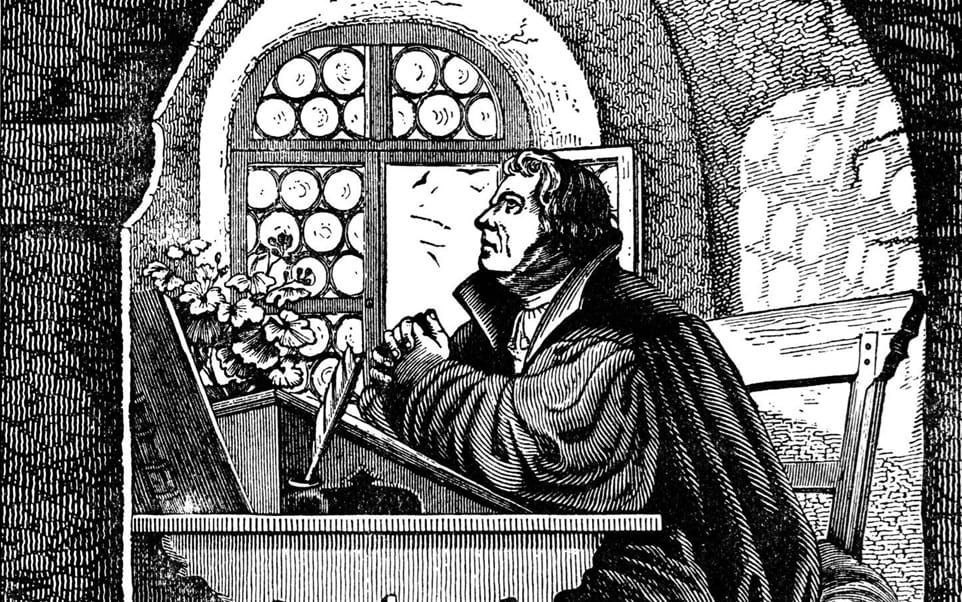
Just as Solomon sought out wisdom, so we have sought out the wisdom of our forefathers. In his commentary on the book, Luther writes:
[Solomon’s asking for wisdom] was a great testimony to the wisdom of this king. And yet so wise and prudent a king did not achieve what he wanted. His schemes did not meet with success, and properly so, for God did not give him this wisdom to make him capable of everything. Therefore Solomon had more labor and sorrow from this wisdom than he did success. He saw that God was pleased when he established his reign properly and laid down the laws for the people; but no one, neither princes nor people, followed him.
If Solomon, the wisest man in Scripture aside from Christ, who had more power to change things than any of us, had such pain at the state of things from his wisdom and inability to alter them, how much more do we lack the ability to change things in our own power with our wisdom? Will not all our efforts come to naught?
So why does God give us wisdom, if all men are powerless to accomplish anything with that wisdom? He gave him this wisdom so that “I would finally learn that I should not trust in my wisdom, and that if God does not will things, they are all in vain…to teach me to resign everything to his will and to see that my wisdom is nothing.” Ultimately, nothing, not even our own knowledge, is built by our own hands. We are not wise because we are better or smarter men than others. We are only wise because God has seen fit to give us this wisdom and to enlighten our minds. It is not our wisdom that we have attained. It is God’s wisdom which he uses to enlighten those whom he wills. This should humble us so that we may not become prideful but instead glorify him for what he has done.
In light of this, the wisest thing we can do is to submit in all things to his will. Luther continues, “For unless God has preceded men with his Word, they accomplish nothing good… For it is not wisdom that accomplishes anything, not even genuine wisdom, but the will of God, so that we learn to pray: ‘Thy will be done.’”
Examples of this throughout Scripture are too numerous to recount. Abraham waiting for the birth of his promised child, the wandering of the Israelites in the wilderness, the sufferings of Job, the life of David, Christ’s life, and countless others. All men were given hard providences from God. They all had wisdom and knew what the Lord required of them but had no practical solution to them that they could accomplish with their own hands. Thus, they had no solution except to commit themselves to the mercy of God.
Luther then closes his thoughts on the chapter with some final words of admonishment and encouragement for the wise Christian:
And so when you are alone and unable to set everything right and straight, commit your cause to him who has more powers and who alone can do everything…Anyone who is very wise has many reasons to become angry, as one who daily sees many things that are wrong. Someone whose eyes are closed knows nothing and does not become indignant.
It is a far greater virtue to see the world rightly and have righteous anger than to be a fool and be happy or indifferent at the state of things. Righteous men in Scripture were filled with rage at the evils of their day, and our modern day is no different. We are right to hate today’s sins—the destruction of the White race, the liberalism in our churches, the evils of the Jews, and many others. But again, we are in such dire straits that we cannot help ourselves. Only God can deliver us. “Unless the Lord had been my help, my soul had almost dwelt in silence. When I said, My foot slippeth; thy mercy, O Lord, held me up” (Psalm 94:17–18).
Although the path of wisdom is no doubt difficult, it is nonetheless the righteous path that receives the blessing of God. We may wish we could change things immediately, but just as the righteous saints in Scripture had to wait upon the Lord, so must wait on him to improve the state of our people. This does not mean that we should not act at all, but it does mean that “except the LORD build the house, they labour in vain that build it.”
In all this, we should have assurance that despite its difficulties, the path of wisdom is worth the pain that it entails. If we walk in the ways in wisdom’s ways, God promises that in his timing, our faithfulness will be rewarded with the renewal of our nation and of our people and defeat of Christ’s enemies.
It is impossible in human affairs to act so well that everything comes out right and no more evils remain. It is most right, therefore, to walk by faith, which permits God to reign and prays that the kingdom of God may come, but meanwhile tolerates and bears with all evils, turning the matter over “to him who judges justly.”
ATTENTION READER:
Institutional trust is at record lows. But without institutions, we cannot renew our people, much less provide an inheritance to posterity. In response to this crisis and as an organic outgrowth both of necessity and natural interest, American Mantle exists. And so we make our appeal.
Donate to the Cause. Help us reach our monthly goal in order to solidify this crucial institution.