The Decline and Fall of the Southern Presbyterian Church, Part 4
The PCUS increasingly embraced racial activism, helping drive conservatives toward forming the PCA.
On May 14, 1969, James Forman, an official of the (Marxist) Student Nonviolent Coordinating Committee (SNCC) presented a Black Manifesto at Riverside Church in Manhattan (UPCUSA), sponsored by the Interreligious Foundation for Community Organization (IFCO), “a funds conduit used by the Presbyterian Church US.”
The Manifesto stated in part:
“Our fight is against racism, capitalism, and imperialism, and we are dedicated to building a socialist society inside the United States where the total means of production and distribution are in the hands of the state, and that must be led by black people, by revolutionary blacks who are concerned about the total humanity of this world.”
The manifesto demanded $500 million from white Churches and from synagogues, with blacks uniting “to help force the racist white Christian Churches and Jewish synagogues to implement these demands.”
On June 11, 1969:
“[The] Presbyterian US Board of Christian Education officially ask[s] the Church to consider receiving spokesmen for the Black Manifesto by invitation…”
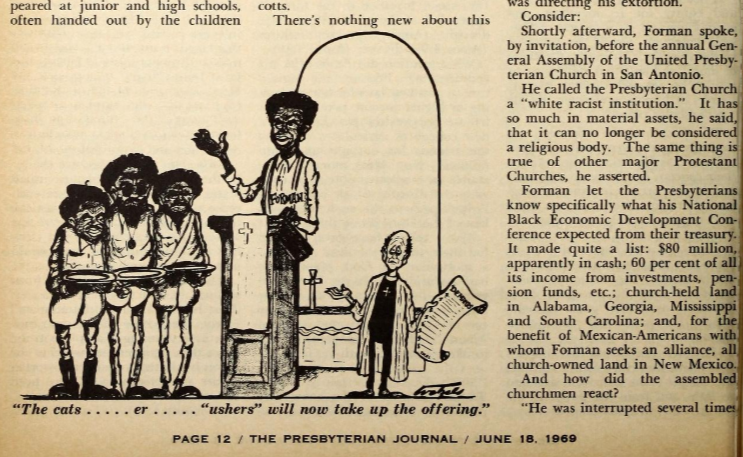
On June 18, 1969, the Journal reprinted an editorial from the Tampa Tribune after the UPCUSA invited the black militant James Forman to speak to its GA.
“He called the Presbyterian Church a ‘white racist institution.’ It has so much in material assets, he said, that it can no longer be considered a religious body. The same thing is true of other major Protestant Churches, he asserted.
Forman let the Presbyterians know specifically what his National Black Economic Development Conference expected from their treasury. It made quite a list: $80 million, apparently in cash; 60 per cent of all its income from investments, pension funds, etc.; church-held land in Alabama, Georgia, Mississippi, and South Carolina; and, for the benefit of Mexican-Americans with whom Forman seeks an alliance, all church-owned land in New Mexico.
And how did the assembled churchmen react? ‘He was interrupted several times by loud applause,’ reported the New York Times…
Afterward, an optimistic Forman told reporters he didn’t believe it would be necessary to resort to violence to gain his demands ‘because the Church is responding.’…
For these gentlemen, no demand can be too outrageous if made in the name of world peace or racial justice. Lawlessness becomes moral protest, surrender to aggression becomes an act of peace, and extortion becomes rightful recompense.
We would not be at all surprised to see churches turning over money and property to Forman and his little band of blackmailers. No doubt ‘Reparations Sunday’ soon will be added to the collection schedule of some denominations.
Whatever you think of Forman’s methods, you must admire the man’s genius. Who else would have thought up such a wonderfully easy way to rob a church?”
On July 9, 1969, the PCUS Council on Church and Society urged the denomination “to take the James Forman manifesto ‘seriously,’” saying that Presbyterians have a responsibility:
“to try to understand the situation out of which it arose, to accept in it the truth we cannot deny, and to respond to what we discern as God’s will for us in this moment in history.”
Recommendations to White church sessions included the need to “present the case of black people in their community.”
On Aug. 27, 1969, a black man named Pastard, “a leader of the militants who have been disrupting church services with the demands of the Black Manifesto,” was invited by the PCUS to a conference in “Montreat, the mecca of Presbyterians.” His “expenses were paid and he was welcomed as an important dignitary.”
Previously, the Presbyterians had him arrested and secured a restraining order against him, a copy of which he “cheerfully burned on the front steps of the church the following Sunday.” The church then sued him for damages in the amount of $100,000.
“Obviously, the contacts established by Mr. Pastard with Presbyterians made him a logical choice for a prominent spot in the Montreat summer program. So he was brought to the Presbyterian US conference center with benevolence money that no doubt had been given to the Lord, and offered the hallowed pulpit of the Anderson Auditorium. Theme for the conference to which he spoke was ‘Reconciliation.’”
On Sept. 17, 1969, the Journal reported further on James Forman of the “Black Manifesto” and his demands for a half billion dollars in reparations.
“To extract the funds, the manifesto calls for ‘total disruption of selected church sponsored agencies… Black workers, black women, black students, black unemployed are encouraged to seize the offices, telephones, and printing apparatus of all church agencies and to hold these in trusteeship until our demands are met.’
The manifesto concludes in saying, ‘Our objective in issuing this manifesto is to force the racist white Christian Church to begin the payment of reparations which are due to all black people, not only by the Church, but also by private business, and the United States government.’ The money demanded ‘is only a beginning of the reparations due us as a people.’
[Forman is] perhaps the first anti-Christian to find entree into the hallowed halls of a Presbyterian Assembly. The United Presbyterian Church [UPCUSA]…paid his expenses to come to the Assembly meeting in San Antonio…
One sincerely wonders whether Forman is not seen in the eyes of some ‘new breed’ churchmen as someone who can contribute to their so-called ‘quest for mission.’…
Now surely all of us Christians are deeply concerned about peaceful race relations. But the means being used by these invaders of our churches is even deplored by the best people of the colored race, and they are thoroughly ashamed of what is happening, as are we all.”
In complete contradiction to that optimistic last line, on Oct. 15, 1969, blacks in the PCUS issued a document “not intended to replace the demands made upon white churches by the Black Manifesto.” The “document calls on every court of the denomination to create a committee to fight institutional white racism.”
“This body unanimously urges the Presbyterian Churches in the United States to hear Mr. James Forman if he appears before them. We also urge them to give serious consideration to his presentation…
Said the paper: ‘The good faith of whites to proclaim and carry out the Gospel of Jesus Christ will be shown when the Church will organize itself at every level to fight institutional racism.’ The blacks contend they occupy the servant role in a master-servant relationship in the Church, and that if this continues, ‘we cannot call ourselves Christians.’
The document’s introduction also charged: ‘The history of black people in the Church has been a painful one. It has been separate and unequal, the blacks being always at the bottom. At no time in the history of the Church has it reflected, by its actions, a Christian concern that will show that it considers its black members as its brothers in Christ.’
Suggested as the principal tool in eliminating white racism was the organization of committees in every court of the Church (from Assembly to session) ‘to fight patterns of racial discrimination.’…
[Also suggested was] ‘Church deposits in black banks and black savings and loan institutions. The largest price tag listed in the caucus paper is $5 million. Such an amount should be made available, according to the document, for black church use in high-risk, low-interest loans to ‘small entrepreneurs’ and businesses.’”
They called for millions to fund “various projects in black churches throughout the denomination” and to achieve “an effective black ministry.” They called for doubling support to black Stillman College. “Endowment of the college should also be increased to $10 million, and wealthy Presbyterians should give more to Stillman than to white institutions, the caucus suggested.” It called for “the Church to give over land it possesses” and to create a new denominational agency, a “black affairs bureau,” with its duties to include the “creation of a positive and true image of the black man in America, development of ties with the dark nations, and maintenance of a headquarters in a major city.” They called for the Church to assist in removing “every barrier that stands in the way of black participation in the democratic political process” and pay for “programs in art, music, drama, black history and literature, and interpretive dancing; and assistance in recreational programs, providing playgrounds, swimming pools, and trained personnel.”
On Feb. 18, 1970, the Journal reported on a new “race office” being opened by the Atlanta Presbytery of the PCUS, led by a newly designated “race consultant”:
“Church officials believe he is the first Negro to serve as a member of a regular staff of a white presbytery in the Presbyterian Church US.”
The Journal hosted a rally in August of 1970, at which W. Jack Williamson of Greenville, Alabama, expressed the need to begin to break away from the PCUS. He said: “Radicals, determined ecumenists, have a timetable for the liquidation of the historic witness of the PCUS.” Race was the driving factor for this, but there were many other concerns as well. The general way in which the need was described was to maintain purity of worship. They echoed Charles Hodge in that what drove them away was the shift in the direction of the church from ecclesiastical to civil affairs.
On Feb. 17, 1971, a black caucus met to discuss the potential merger of the UPCUSA and PCUS. They approved a document entitled “Diversity and Inclusiveness in the New Church,” which stated:
“[T]he new Church will seek to redress past discrimination against certain racial groups within its membership by assuring representation of black members, Hispanic-American members, Indian-American members, and Asian-American members in all judicatories above the session and in their boards, agencies, foundations, commissions, and permanent committees, in numbers not less than four times the proportion of such membership in the total membership of the judicatory.”
On Oct. 20, 1971, the Steering Committee for a Continuing Presbyterian Church, which would become the PCA in 1973, was announced in the Journal.
“Among the questions raised by pastors and elders at the meeting were some on whether the continuing denomination would be national in scope and racially inclusive…
Answering the question on the race issue was Ben Wilkinson, staff member of the Presbyterian Evangelistic Fellowship. After citing many ministries in which Presbyterian evangelicals are involved with blacks, he requested participants to help put the steering committee in touch with black pastors and elders who might be interested in the continuing Church.
Mr. Wilkinson emphasized that the denomination would be racially inclusive. He added, ‘We are not a racist group seeking to build a racist Church.’”
The 1972 PCUS GA pronounced its will on prison reform, South African apartheid, the school crisis, and called on state legislatures to ratify the feminist Equal Rights Amendment.
On Aug. 9, 1972, the president of Louisville Seminary presented the draft for a new confession of faith to the PCUS, which contained this:
“‘His wrath is provoked when racism denies minority people position and power, and sexism prevents women from rendering full service in the life of the Church itself’ (VIII, 2)… The confession includes all the affirmations a dedicated liberal would consider vital, in the areas of race, sex, economics, and political action. In fact, it can be considered a mandate for anything imaginable in liberal religion or social action, while at the same time not avoiding the language that evangelicals consider essential in a confession of faith.”
—Gold, p. 194
On Dec. 4, 1972, the National Presbyterian Church, which would later change its name to the PCA, was formed, 112 years to the day after the formation of the Presbyterian Church in the Confederate States of America.
Before we turn to the PCA, here follows a brief overview of how the PCUS progressed in the years ahead. During this time, many churches were gradually transitioning to the PCA.
On March 21, 1973:
“[T]he chairman of the Southern half of the PCUS-UPCUSA joint union committee was quoted in the Survey as dismissing…advocates of the Continuing Church [PCA] as racists…”
On April 17, 1974, all talk of racial preservation and free association among the clergy was gone. In the PCUS, the focus of all race-related discussion was no longer on Marxists pushing a racial agenda of theft through the WCC and other entities, and funding Marxist revolutionaries around the world, especially in Africa. Instead, race became a “problem” in itself, as you can see here, where a writer mentions:
“war, divorce, immorality, race, and all of the other problems facing our world. All of these problems originate in the sinful heart of man… The Church needs to recognize that the problems of crime, divorce, drugs, race, and all of the others, are simply symptoms of the disease called sin. Then the Church must preach Jesus Christ, who alone is able to cure this disease.”
On March 19, 1975:
“Project Equality is a pressure organization of the Churches (to which units of the PCUS and the UPUSA belong) which sets up boycott lists of companies that do not satisfy the employment guidelines (of Project Equality) in respect to race. In other words, if it should turn out that Sears Roebuck does not have as many blacks in top managerial positions as Project Equality demands, the company will get an ‘affirmative action’ request which, in plain language, means that unless the company complies you will boycott it. That is, if you belong to a Presbyterian denomination that supports Project Equality.”
From then on, all White discussion of race fell in line with federal mandates that outlawed preferential treatment, not only for race but also for sex, religion, and national origin. White churchmen only began to use the word “race” positively in the sense of “the human race” or “the new mankind” or “the new race in Christ,” even as they were being told that they couldn’t restrict hiring to Christians in their church offices! Negatively, their favorite usage of the term was against “Nazi-style ‘master race’ mentality.” Nationalism was replaced with a neo-Babelist Utopianism.
Here’s a representative article on Dec. 31, 1975:
“God gave the old human race a fair chance…and it failed… There are two races of men on earth… Men naturally group together around some spot, perhaps some name, family, or race, or along political, national, or patriotic lines. But God has passed by all these. He is building a new society that is neither English, American, French, nor German, neither monarchial nor republican.”
Of course, blacks were having none of this. See this article from Aug. 24, 1977:
“In a major shift from the Martin Luther King tradition of nonviolent social action, top black Church leaders and theologians of America have voted to endorse violence as a justifiable weapon, declaring that they may have to resort to violence in this country to achieve their goals.
As the ‘only institution over which black people have total control,’ the black Church leaders declared here, the black Church must lead the way in a new struggle for ‘freedom from injustices, racism, and oppression.
Their statement, adopted by the national conference of the New York-based Black Theology Project, said they identified with ‘black people wherever they may reside, one with and inseparable from our brothers and sisters around the world who fight for liberation in a variety of ways, violently and nonviolently. We affirm whatever method they decide is best in their particular situation and make no pious and hypocritical value judgments which condemn those efforts to bring an end to their oppression, recognizing that we in this country may ourselves be compelled to make a similar choice,’ the theologians said.
‘This is black theology’s answer to Billy Graham Crusades,’ said the Rev. Muhammad Kenyatta, a Baptist minister from Philadelphia who heads the project which brought 175 Church leaders here.
The statement defines black theology as an ‘understanding of the Gospel as freedom and Jesus Christ as the Liberator.’
Keynote speaker for the conference here was the Rev. James Cone of Union Theological Seminary in New York. Dr. Cone’s book, Black Theology and Black Power, is generally conceded to have become the premiere treatise on black liberation theology.
Some fifteen percent of the conferees were Presbyterian.”
All along, the WCC and NCC, which were supported by donations from the PCUS and UPCUSA, only escalated their Marxist agenda. This article from April 15, 1981, states that these organizations had given “hundreds of thousands of dollars…to terrorist and revolutionary groups through what it calls ‘The Program to Combat Racism.’”
“[One] WCC apologist said the issue is precisely one of confessing Christ as Lord in the context of the political sphere. (That’s correct: Blacks killing whites is ‘confessing Christ as Lord...in the context of the political sphere.’)… To oppose the use of the Lord’s tithes for the purpose of killing would be a bit like ‘telling the freedom fighters of the Dutch and French underground in World War II that they should seek to liberate their homelands from the Nazis by peaceful means,’ this Presbyterian churchman continues… And he quotes, with approval, the words of Colin Winters from Namibia, who said that ‘armed struggle is the only alternative left to a voiceless, powerless people.’”
On June 30, 1982:
“In the Presbyterian Church US (PCUS), they let their teenagers (sometimes very young teenagers) speak on the floor and even vote in committee meetings. These ‘youth delegates’ sometimes are refreshing in their candor and occasionally drop a bit of wisdom exceeding that of their elders. In Columbus, Ga., the Committee on Justice and Humanity of the PCUS was about to suggest that there was no further need for Southern Presbyterians to address themselves to the issue of racism. Then 17-year-old Ken McGowan of Chattanooga spoke up. He said, ‘I know people my age who are racists and proud of it. I know others who are racists and don’t know they are. I’m a racist, and I feel this overture is needed.’ The measure ‘to commit the church programmatically and financially’ to raise the issue of ‘white racism’ to a ‘higher priority’ throughout the PCUS passed overwhelmingly.”
The UPCUSA and PCUS finally merged in 1983, becoming the PC(USA). This was made possible because the Southern mainline had finally become as liberal as the Northern mainline, and there was no logical reason why they should not pool their resources.
ATTENTION READER:
American Mantle exists for the renewal of godliness and righteous power in America. We often go where others rarely dare, directly addressing taboos on faith, ethics, politics, and history.
We are Americans by blood and soil. Our own forefathers conquered and cultivated our homeland, and through great faith, bold strategy, and statesmanship secured the blessings of liberty to themselves and their posterity. We are their posterity, and we resolve to follow them. Join us in this mission.
Donate now to support us.