Polypolitics: A New Framework for Political Valuation
We can do more than emote or smear: we can act with motive power.


In the past several months, we have witnessed an unmistakable pattern of the political Right fracturing into distinct factions. Sometimes this happens formally, often informally—but nearly always with considerable hostility. Smears fly; personalities become polestars; and good-faith interaction is aborted. What might have been reckoned as disagreement over tactics, emphasis, or presentation is escalated into existential enmity, forcing even conciliatory men to pick a side and prove loyalty by pathologizing dissenters.
Responses to this dynamic vary. Some pretend the fractures do not exist, or paper over them as trivial. Others acknowledge them and interpret the factionalism as an omen for any number of things: a clear indication that the Right is forever doomed to impotence, a revelation that we must excise and separate from any who disagree with us on the flashpoint, or the inevitable disorder of a social media free-for-all. Whatever truth these interpretations contain, I submit that there is another factor at work: polypolitics.
Polypolitics views the political realm from multiple distinct angles rather than a single binary. It recognizes a plurality of valuations or weights, where conflict arises not from different positions alone, but from different rankings of these dimensions. Polypolitics does not necessarily prescribe priority, however; this is the province of men and organizations. But as a framework, it explains why men who share a broad Rightist orientation still clash fiercely—and why, at times, they align with perceived outsiders or enemies. If we understand not only what a man believes but what he prioritizes, we are better able to predict where he will align, where he will defect, and what interests or loyalties ultimately govern him. We can do more than emote or smear: we can act with motive power.
At present, there are at least ten key dimensions. These dimensions do not operate equally. Men and movements rank them—consciously or not—and it is this ordering that produces alignment, tension, or rupture. Polypolitics is therefore not a plea for civility or reconciliation; politics is not a dinner party, and factions do not fracture merely because they misunderstand one another, though at times that is a factor. Rather, polypolitics is a method of classification and power analysis. It reveals the loyalties beneath political speech, clarifies where men and movements will break under pressure or might otherwise come together, and exposes the deeper structure of factional conflict. Where surface labels like “Right,” “Left,” “conservative,” or “populist” often conceal fundamentally different rankings of interest, identity, ambition, and power, polypolitics foregrounds them.
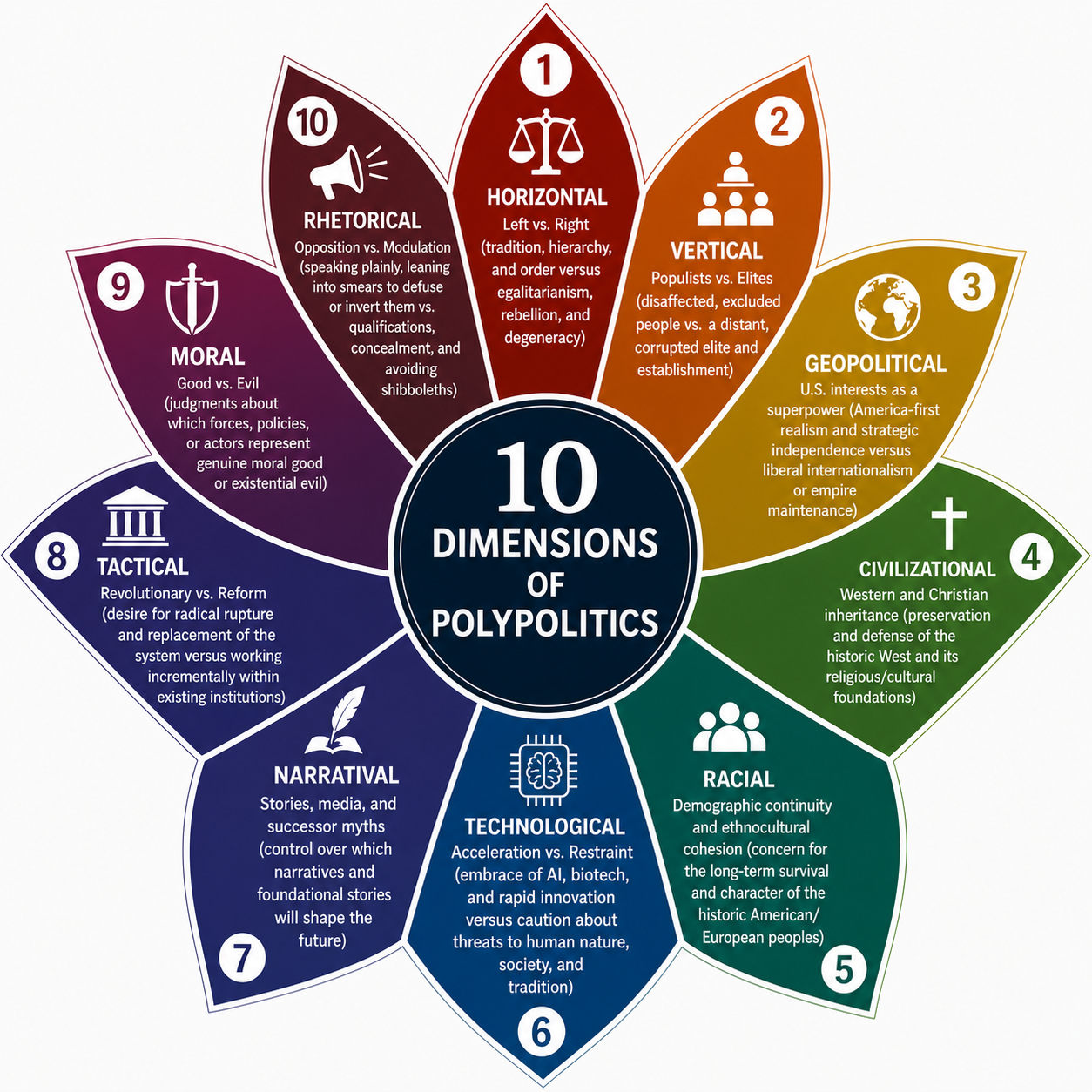
Here are the ten dimensions, first in list and then in graphic format:
- Horizontal — Left vs. Right (tradition, hierarchy, and order versus egalitarianism, rebellion, and degeneracy)
- Vertical — Populists vs. Elites (a disaffected, excluded populace vs. a distant, corrupted elite establishment)
- Geopolitical — U.S. interests as a superpower (America-first realism and strategic independence versus liberal internationalism or empire maintenance)
- Civilizational — Western and Christian inheritance (preservation and defense of the historic West and its religious-cultural patrimony)
- Racial — Demographic continuity and ethnocultural cohesion (concern for the long-term survival and character of the historic American/European peoples)
- Technological — Acceleration vs. Restraint (embrace of AI, biotech, and rapid innovation versus caution about threats to human nature, society, and tradition)
- Narratival — Stories, media, and successor myths (control over which narratives and foundational stories will shape the future, and how to respond to the post-war consensus)
- Tactical — Revolutionary vs. Reform (desire for radical rupture and replacement or upheaval of the system versus working incrementally within existing institutions)
- Moral — Good vs. Evil (judgments about which forces, policies, or actors represent genuine moral good or existential evil)
- Rhetorical — Opposition vs. Modulation (speaking plainly, leaning into smears to defuse or invert them vs. qualifications, concealment, and avoiding shibboleths).
Today, political commentary often reduces everything to the horizontal binary of Left versus Right. Our audience at American Mantle is right-wing, as are we; so the point is not in doubt: the Right properly values tradition, hierarchy, and order against the Left’s egalitarianism, rebellion, and degeneracy. Good men should therefore align with the Right in general, not the Left. But on particular issues, this single axis can prove insufficient. For example, the contemporary Right, especially among elected Republicans, includes figures such as Lindsey Graham, Mark Levin, Ben Shapiro, Randy Fine, and Ted Cruz, for whom Zionism and free-market orthodoxy are dogmas, while White racial identity and anti-semitism are heresies.
Thus, on the specific question of Israel and Jewish power, some Rightists find themselves closer to elements of the Left (which trends anti-Zionist) than to the establishment Right (which is often Zionist). Astute and fair minds will note that these Rightists do so for entirely different reasons than the Left. Where the Left opposes Israel through grievance and anti-colonial lenses, the dissident Rightist who breaks ranks usually does so from civilizational, racial, moral, or geopolitical conviction—or some combination of the same. The disagreement therefore concerns more than foreign policy alone. It reveals deeper rankings of loyalty and power: whether one prioritizes donor structures, geopolitical strategy, racial continuity, moral universalism, institutional advancement, national sovereignty, Jewish power, or allegiance to Trump. The issue becomes diagnostic.
Here polypolitics is essential. Men who stand together on the horizontal Right nevertheless diverge because they weight other dimensions differently: vertical tensions between people and elites, geopolitical calculations of power, civilizational defense of the West and its Christian patrimony, tactical choices between infiltration and revolution, and moral judgments of good versus evil, among others. Without this fuller map, every policy disagreement becomes a loyalty test and every split hardens into permanent rupture. With it, we can locate the precise axes of conflict, distinguish tactical convergence from genuine loyalty, and transform raw fracture into intelligible contest. Under conditions of stress, the weight a man ascribes to dimensions will determine where he bends or breaks, where he remains silent or agitates, and where he openly defects or will play the martyr. Political crises create loyalties and expose the hierarchies of loyalties.
More than a framework, however, polypolitics also describes a historical phenomenon. It accompanies a diagnosis that many on the Right already recognize: the accelerating collapse of the post-war consensus. That order, rather than eliminating these questions, suppressed and synchronized them within a managed equilibrium. Now we inhabit a liminal interval in which suppressed questions of race and class, civilizational continuity and elite legitimacy, and technological power and national survival reassert themselves with increasing intensity, variety, and spontaneity. As I said in Vine and Iron, this is a generative moment. Priorities shift, alliances fracture, the boundaries of the possible expand and contract in rapid succession—these upheavals are not aberrations but the conditions under which new orders are formed.
I have my own convictions about how these dimensions should be ranked, as well as when to break ranks or form new ones; but that is a task best left for another essay. My only charge is this: we must learn to see politics in full, or we will forfeit the capacity to shape what comes and to seize what is ours.
We must re-imagine politics—or perish.
ATTENTION READER:
American Mantle exists for the renewal of godliness and righteous power in America. We often go where others rarely dare, directly addressing taboos on faith, ethics, politics, and history.
We are Americans by blood and soil. Our own forefathers conquered and cultivated our homeland, and through great faith, bold strategy, and statesmanship secured the blessings of liberty to themselves and their posterity. We are their posterity, and we resolve to follow them. Join us in this mission.
Donate now to support us.