The Unprotected Class: A Review and Rebuke
Jeremy Carl and Vivek Ramaswamy are, if not fully agreed, at least closely aligned on what constitutes American identity.

What do Chris Rufo, Rod Dreher, Victor Davis Hanson, Charlie Kirk, Heather MacDonald, Peter Kirsanow, and Tucker Carlson all have in common? Each one wrote a blurb for Jeremy Carl’s book, The Unprotected Class. The combined praise from this conservative pantheon is robustly repetitive: in his “outstanding book” Carl “bravely exposes, documents, and names the racialist ideology that is tearing America apart.” It’s a “stunning work of exceedingly rare bravery.” It’s a “prescient, landmark book” which can help you figure out the “pathological war on white people in America.” Carl explains the “taboo” of “using the word ‘white’ non-pejoratively” and “demolishes the false narratives about race.”
So says the pantheon. But is this the full story?
It is not.
Carl commences his introduction by reviewing the seminal parts of the Summer of Floyd and by foreshadowing, through a series of questions, the content of his book. How did we get here? How did the civil rights revolution run off the rails? How can we correct course? And why is it necessary that we do so? The book is, allegedly, dedicated to asking and answering these questions (xiii).
Carl admits that the narrative of “white privilege” is rapidly changing, but, in a confession of conservative modesty he assures us that his “arguments” run against “officially approved narratives,” (xiii) just before he takes an ironic jab at Buckley, garnished with Latin (xiv). Democrats have waged war on White Americans, Carl notes. And Republicans, if they even manage to mount something tantamount to a defense, are typically tepid, though Carlson, Kirk, and Walsh are exceptional stalwarts (xiv). Republicans have impotently defaulted to the exclamation, “I don’t see color” in the midst of anti-White animus.
But Carl isn’t writing for Whites, nor for White Americans; no—like the liberal, this rare brave man who dares fill the breach is writing for “all Americans” (xiv), a term he never defines and which, in practice, means virtually anyone. Carl suggests we must focus on the rights outlined in the Declaration of Independence as a “tactically and morally” superior strategy over focusing on “whiteness.” But he never bothers to define “whiteness” either, or why it’s a bad strategy, nor does he point out that the Declaration was the product of White men.
To be sure, Carl, in a mix of candor and his own form of tepidity, implies that the wrongs done to Whites are because they are White, and that this concerns Whites as a group, not simply as individuals—but definitely not as a race. He doesn’t seem to regard them as such. African Americans—Carl capitalizes this group but not “whites” and not “white Americans”—secured their “natural rights” through MLK’s political organization, and apparently, judging by Carl’s own word choices, they did this as a group, not as a race (xv). No mention from Carl about Jewish involvement here behind MLK.
Carl lists some of his bona fides to assure us of his qualifications to write this book: scholar, activist, government official, and adviser for nearly thirty years. He has served the President, his state governor, the Hoover Institution, and now the Claremont Institute, touching upon race, immigration, and national identity, though he later says his work really hasn’t focused much on race but on environmentalism. The Left, he notes, uses racism as a political weapon and conservatives reflexively self-censor—a dynamic which, he rightly judges, must end (xv). But we can only respond, “Physician, heal thyself” for in the next sentence he betrays his own infidelity to the call: “racism” exists in America today against Whites, he says; but, more than that, he doesn’t deny “in any way” that America’s past includes racism (xvi). In fact, he will confess these sins later.
For whom, exactly, is this double-negative “not-denial” intended? Is this just a negation? Or is something being affirmed, noted, or confessed? If so, what is it? What is racism? Is it bad? If so, why? If not, why not? Where did the word come from? And, whatever it denotes, where was it in our past? What did actual Americans and American laws say about race? Do contemporary assumptions about “race” and “racism” align with or diverge from that? If they diverge, just what exactly is “American” about such assumptions? Carl is little concerned with asking, much less answering, such questions about race and about “discrimination” which he assumes is bad (xvi); so he is therefore not concerned with clarity on fundamentals.
Carl diagnoses that “America is in the midst of a rapid demographic and even civilizational transformation.” So far so good, though note the use of “demographic” here in place of “race”—exactly what R. R. Reno does in his interview at American Reformer last year. Carl, of course, seeks to undertake the work of a balanced diagnostician; thus he doesn’t place “primary blame on non-whites” but on a “small number of elite liberal whites” who, Carl says (quoting the Black writer Zora Hurston), are “of my race but not my taste… skinfolks but not kinfolks.” Carl is being half-honest and half-shy here. He’s not White. He’s Jewish (212). But the unstated assumption here is that he is White, though not White like the liberal Whites whom he blames. In other words, Carl is a Jew—who claims to be White when it can benefit him, and is not White when it doesn’t.
He ends his intro as he began, with a series of questions. What happens when the builders of America lose dominance and become disfavored? What does a post-White America look like? Can America and its institutions survive such a transformation? Carl fears if we do not course-correct soon, then “civil strife” and “racial violence” are coming. Finally, he says something actually useful and fully honest, although in truth both these things are already here and will remain so for some time. Unfortunately, the admission is never meaningfully developed or courageously handled.
The reason for this is that the book is little more than a data dump of surrender. Carl cites facts but cedes frame—everywhere. Of course, he’s not an idiot. So he seasons his submission with the occasional zinger to signal that, though the Enemy has conquered him, his mostly willing service is not entirely unreluctant. Leave it to the conservative and his beautiful-loser way to think that this is a viable strategy to awaken people to existential crisis and galvanize them to action.
Yes, Carl says and documents true things. He says that “a great replacement and a great historical erasure” have happened, and we cannot pretend otherwise; he even later capitalizes it—capital-G, capital-R “Great Replacement” (154)—and claims that “anti-white discrimination in America has become a matter of life and death” (194). He says that, though we are now a multiracial, multicultural country, nevertheless, from the American Revolution forward to Hart-Celler, we were effectively a supermajority White country; that Wokery and anti-White evil, with all their tentacles, have reached into many domains—education and academia, business and the workplace, entertainment and politics, real estate and history, jurisprudence, criminal justice, tech, and otherwise—and wrought chaos, oppression, and dispossession; that the Civil Rights regime, as Caldwell has argued, is really a revolution and effectively acts as a new Constitution; and all such things. He even admits that race is “rooted to some degree in biology” (203). Granted. But saying true things is not always brave; cowards can do that. More than that, Carl is not the first to say these things, nor will he be the last; and, while compiling the data in a book makes for a handy reference manual and we can appreciate the labor requisite for such a product, it does not make for an actual solution commensurate to the crisis.
On the one hand, Carl nowhere tells the reader that he is willingly reconciled to this crisis, for he never expresses this in these or similar words, and, having written the book ostensibly parsing through the crisis, you’d think he wouldn’t be reconciled to it. On the other hand, he confesses ad nauseam that he is reconciled to the crisis, which will be evident to anyone who takes the time to think beyond tropes, discerning his priors and their ramifications. Men always tell us who they are, if we will only listen. Carl has swallowed, digested, and regurgitated the liberal and egalitarian axioms of the Enemy, not rejected them. So much is clear from the start to end of the book. Lest you think I am being harsh or pedantic, I will now vindicate this assessment with so many proofs.
First example. Remember the lack of definition of “American” earlier? There’s a reason for that. As best I can judge, Jeremy Carl and Vivek Ramaswamy are, if not fully agreed, at least closely aligned on what constitutes American identity. For Carl, there are East Asian Americans, South Asian Americans, Iranian Americans, Lebanese Americans, Turkish Americans, Argentinian Americans, Ecuadorian Americans, Cuban Americans, Ghanaian Americans, Nigerian Americans, Egyptian Americans, Native (Indian) Americans, African Americans, and, last but not least—and the only one not capitalized in the book—white Americans (6-7). Presumably, Mr. Carl would have no qualms with Ewok Americans and Bigfoot Americans either, though, admittedly, they have yet to assert their natural rights.
Second example. Carl says:
“America’s successes were what brought us from a tiny outpost of civilization to the world’s pre-eminent superpower in the course of a bit more than 300 years. And these were by and large the successes of European-descended Americans. This isn’t a statement of white supremacy—it’s just one of basic history and demography.”
As I noted in Vine and Iron, and as you need to discern, conservatives have accepted the moral vocabulary of the Enemy. This means they concede moral legitimacy to the Enemy—to their convictions and their claims, to them as a collective actor undertaking total conquest on the stage of American and Western history. Carl and men like him don’t want to win; they don’t even want to fight back or defend you; they just don’t want anyone to think they are bad. That’s too bad. That’s not how the world works, that’s how you lose, and Christ, who is World Victor, has pronounced woe on those who seek to be spoken well of by all men; thus we can’t afford to let this rot remain unaddressed.
If the statement is not White supremacy, then is it White equality? If not, then is it White inferiority? What do you gain by denying this is White supremacy? What do you yield? Have you not said, without saying it, “these are just facts, but they have no moral weight, and they are not at all reflective of the White people, and certainly they should have no bearing on their collective self-assessment, their confidence, their outlook”? If, as many today think and as our own American Founding fathers thought, “white” is a word to encapsulate a race composed of European ethnicities, and if, as a race, we ascended to “superpower” status, dominant across many sectors, is not “white supremacy” a proper term for this? If the Enemy who uses the term “white supremacy” is doing so in order to denote the greatness of our ancestors which he despises and is actively erasing, then, if we as their posterity deny this as if it is a black mark, are we not castrating our souls and joining with the Enemy in the sacrilege of our own? Have you not confessed by your denial, “I can be leashed by a mere word”? Why, then, should you have anything? Why should anyone follow you? Why? You have confessed yourself worthy of nothing and no one.
Third example. Carl notes the ideological agenda of interracial relationships and friendships in media as a form of racial myth-making (145); but he doesn’t oppose either in themselves, nor as socially imprudent, nor as injurious to national life, solidarity, and cohesion; instead, he opposes them only insofar as they over-represent the present, are not popular, and forward an unstated agenda (146). Carl is not interested, therefore, in particular identity vis-à-vis race, but in what we might call honest representative equality of the present or of what’s popular. Presumably, if America were composed of 80% interracial relationships, or if the idea in general were wildly popular, then he would want this reflected proportionately in media displays. He admits the presence of anti-White propaganda but cannot muster a pro-White response, much less a distinct White identity rooted in the Founding or somewhere subsequent to be embraced, preserved, and protected as essential to and exclusive of American identity.
Carl raises the play Hamilton, named after the White founding father, Alexander Hamilton. Specifically, Carl notes its “color-conscious” casting. Most of the cast of the original production, he reports, were African Americans, with two exceptions: a Puerto-Rican American (add another to his grand masterlist) and an Asian American. Remarkably, Carl doesn’t oppose this but honors it—as giving “ownership” of the Founding to “all Americans,” and in a “hip-hop context” no less, a “praiseworthy monument to national integration” (147). Carl, however, is schizophrenic. Pages earlier, he excoriates Wakanda, the idea of a “high-tech Afrocentric paradise untouched by whites,” as something that is “beyond historically illiterate” (143), demonstrating his willingness and ability to target and fire. Or, to give him more credit, Carl is precise in his commitment to betrayal: when it comes to the dilution of the American inheritance in Hamilton, he is conciliatory and even laudatory, but, when it comes to the Afro-paradise of Wakanda as envisioned in Black Panther, Carl is ruthlessly defensive of the truth of Africa in history. In their case, it never happened and never could have happened. In our case, it has happened and it’s a good thing. Sympathetic indulgence to commend Negro Hamilton, despite its historical absurdity; surgical rigor to condemn Wakanda Foreva, despite its admitted fiction. In both cases, he sides with the minority.
To be fair, Carl highlights that the villain of Hamilton, King George III played by White man Jonathan Groff, is portrayed with a “foppish, gay insouciance” and is a figure of mockery excluded from the American story. Thus Carl remarks coyly: “One suspects this is no mere accident of casting.” He then admits the Black casting is erasure of history and truth, that it confused his own children, and that it agrees in spirit with the removal of American monuments (147-148), culminating in an “unsettling message.” But why would Carl be unsettled, given his prior praise? Carl admits such casting marginalizes “white stories” and “white history” (149), but he is not being forthright or consistent from either side: he had already admitted that America was overwhelmingly White, which means that White history (in America) is American history; yet, at the same time, why should he care that the particularities of race in said history are being misrepresented in the present, given that virtually anyone can become an American in his view? As he notes, the “Founders were, in fact, white men” but “it is possible to acknowledge this without denying the universality of their message or the ability of Americans of all racial backgrounds to embrace the Founding today” (148). He never tells his reader that if the Founding laws and sentiment were applied today, only one type of his many Americans would be welcome as Americans and that he would be laughed out of the room.
Fourth example. Carl assures us (who really doubted?) that he has “never even remotely advocated for white nationalism, which would be completely destructive of the fabric of American society” (155-156). This—the same conservative self-censorship he notes in the introduction as endemic to Republicans—comes on the heels of being accused by Congressman Raul Grijalva of being a “white nationalist.” Who knows what “white nationalist” means here, other than that it’s something terrible. Carl never defines it. Regardless, we must have equal justice for White Americans, Carl says, because this is the “only way America can succeed as a multi-ethnic country.” What has Carl just confessed in his denial and in his call for ‘justice’? He accepts the racial revolution of America, even though it is contrary to our own history and laws; he is not opposing it and has no intention of doing so; in fact, the only way to succeed, he says, is to surrender.
Fifth example. Carl rightly asserts that “demographic replacement is more important than economic opportunity” (193), that the “H-1B influx” to Silicon Valley destroyed wages, White tech workers, and community (191), and that such things are facilitated by internal minority-hiring quotas of companies like Google where those hired sometimes lack the skills needed for their respective positions (188); yet his solution is not to fire these people, seize their assets, and send them back to their home countries, or anything approximating that, but for them “to develop skills to be hired into positions that are vital for business success” (189). They’re Americans, after all, or given enough time and expropriation of America, and at least one viewing of Hip-hop Hamilton, they can become Americans—kinfolk, not skinfolk, to the Founders. Washington, as we all know, crossed the Delaware so that Shaniqua, Praveeti, Muhammad, and Wing Chun would compose the apotheosis of American identity.
Sixth example. American religious institutions, says Carl, “once struggled with anti-minority racism” (212). The church in the past “failed on racial issues” (212) and “embraced racism against minorities” (217). Specifically, it failed in its defense of slavery and of segregation, in the burning of witches, and in “other practices that Americans today abhor.” Apparently, the mere abhorrence today of things done in the past means that those same things were moral failures. Carl then goes on to essentially document various Woke policies inside mainline churches (and the detriment of them) as if they are problems to be critiqued. But the whole basis of these policies in the first place is exactly what Carl has already granted as true: that racial evil was done in our past and we must not repeat it. He may disagree with some of Dr. Woke’s prescriptions; he has not disagreed at all with the diagnosis. Virtually no conservative does. Thus, as I have said before, their axial spine is little different than liberals and leftists. The Woke, the Left, Liberals, and Conservatives are all agreed on this: that racial evil took place in the past, that we must not repeat it, that this is part of American identity, and that Whites especially must not possess any collective identity to claim what is theirs. Incidentally, this is also the section where Carl designates himself a “Christian of Jewish descent.”
Seventh example. Carl cites Voddie Baucham and his book Fault Lines, noting that Baucham, who once accepted CRT as a young Black pastor, predicts a race war, doesn’t deny “anti-black racism” in American Christianity’s past, and has been accused by Blacks for “robbing the black church” by speaking to White congregations (219). Carl never asks whether there is any sense of truth in this final point with respect to natural relations. Again, this is because he grants the racial egalitarianism and “anti-racism” of the Enemy as morally normative. He notes with Baucham that “CRT substitutes anti-whiteness for Gospel truth” which they claim is a form of “Ethnic Gnosticism.” The Gnostics of the post-apostolic era did not merely claim secret knowledge; they denied the goodness and significance of the body and thus of nature, which applies by extension to race. Thus, in truth, it is Carl and Baucham who are guilty of Ethnic Gnosticism: rather than deal honestly with the issue of race, they mystify it by imposing gospel categories upon it, on the one hand, and by denaturalizing it or dismissing it, on the other.
Neither Carl nor Baucham honestly answer the Enemy; instead, they strawman. For example, Baucham says, contra the CRT of the Woke, that all are under guilt and sin, and thus it “is not the state of white men” but of “all men.” But the Enemy isn’t making a universal-soteriological claim about White men with respect to God; they are making a racial-sociological claim with moral, political, and historical implications with respect to man and nation. Therefore, neither Baucham nor Carl have posited a real answer. They and those like them simply change the subject, conjure categorical specters to knockout, and pretend like they have won the match. And Baucham, though he has rejected the total theory of CRT, has not rejected but retains the anthropological priors upon which it rests. But even he is not entirely consistent: years ago, he relocated his family from America to Zambia, in part because, once he had visited Zambia, he felt kinship with the Zambians, describing them feelingly as his own people. When he does it as an African man, it’s a glory; when you do it as a White man, it’s bigotry.
More could be said. But this sampling should suffice.
To his credit, Carl does indict Jews on several counts: creating space and calling for slavery reparations (which Carl doesn’t oppose in principle), anti-White political and legislative outreach, affirmation of Black Lives Matter, parroting the Woke narrative of White oppression in past and present, notorious ethnic tribalism, and their hypocritical segregation, among other things. While we can praise Carl for the willing indictments, they are nevertheless quite trivial when situated in the wider context of his work where he simultaneously critiques and concedes.
If Carl is a brave truth-teller, and if his book is an outstanding landmark, as the blurbs claim—this can perhaps be partially granted with respect to the organized data and some other things—then, being as charitable as possible, he is also a hedging gentleman and the book is milquetoast conservatism, meager in usefulness and in ways a great harm—if we’re being honest about his priors, his framing, and our own history. Maybe Carl is a decent guy. So what. That doesn’t qualify him to speak with authority. Even if it did, the man has no unction and nothing to inspire us with.
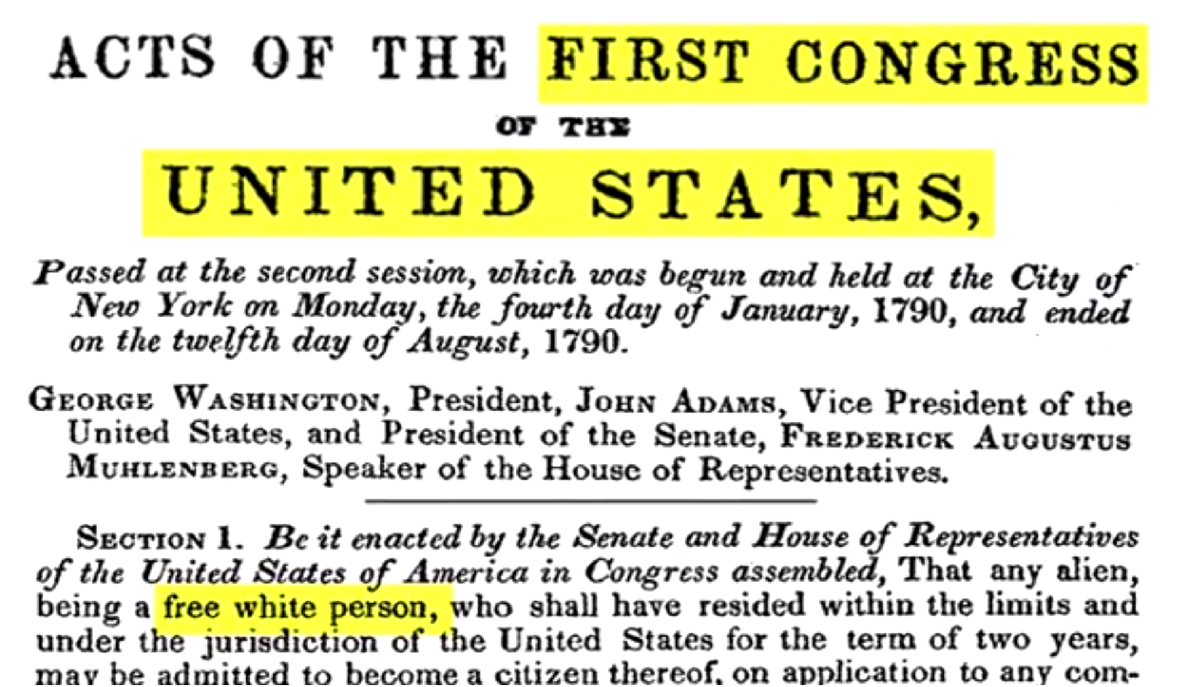
The Founders enshrined race into law. From the first, second, and third naturalization acts forward—1790, 1795, and 1798 respectively—citizenship was restricted expressly to “free whites… of good character” for nearly a century. These measures were ratified by Presidents George Washington and John Adams (both White), at a time when Congress was entirely White (and male). This is the Founding. These are the Founders. The so-called “message” they articulated, to whatever extent such a thing existed, was of them and for them and for their own—not for the entire world. The blessings of liberty in the Constitution they expressly claimed and deposited to their posterity—their loins, their own flesh and blood, an actual distinct people, a race—thus not an amorphous mass into which any and all people can be included simply because they touch our magic soil and say some magic words. The Founders did not conceive of assimilation and integration into America as raceless, though they could have; and they certainly did not conceive of America itself as raceless, and they couldn’t have, as even Carl notes: it was White.
Ultimately, Carl does not advocate for Americans to reclaim what is theirs; he only suggests that Americans have an equal share in what others have stolen from them in the name of “American.” He doesn’t call Americans Americans; he qualifies them as “white” Americans, and obsequiously shoehorns them into a mosaic dilution full of non-Americans posing as Americans. Contrary to his claims, he therefore does not do justice—not to the crisis, not to Americans themselves, nor to the American Founding and inheritance, nor even to the non-American posers whose native identities are apparently so transitory and trivial as to be discarded at will in their sacred pilgrimage to the land of everyone. Carl retreats and reconciles. He does not oppose and certainly does not lead. Instead, he poses two options: inter-racial score-settling vs. a functioning multi-ethnic democracy (254). In the midst of our multiracial crisis there is a multiracial “hope,” he says, “not just for white Americans but for all Americans” (263).
Carl is right: I am one of those “passionate advocates” who finds his proposals “insufficient” (265). But I suppose, so long as we are making such descriptions of one another, that this makes Carl a half-hearted concessionist who seeks to please everyone. In any case, yes, Jeremy, a due response will require “force” and “violence”—just exactly what else should we expect to be done to invaders and expropriators? —how else is ICE supposed to fulfill its mandate? —what is the sword, which God has given the magistrate, for? —and do you not understand that, outside the anomaly of Liberalism, such things are normative politics?
No, Jeremy, I am not interested in a “new American ethnicity” of “multiracial whiteness”—an oxymoron if there ever was one—where different non-White ethnicities and races “identify themselves with the culture, legacy, and interests” of America (266) and we “accept immigrants from everywhere” (274), where anti-American fraudster Vivek Ramaswamy is governor of Ohio, where you write the academic and policy justification for his Indian chicanery, and where you shamelessly wrest “ourselves and our posterity” for a “future multiethnic America” (274)—contrary to the conditions and intent of the founding Americans and of their progeny. I bear no attraction, indeed, I am provoked and bear only righteous revulsion to such craven infidelity and the amalgamation of the heritage which my American fathers bequeathed to me, doubly so because you falsely brand what you offer as faithfulness. You could have saved the space and simply said “I recommend multiracialism as a solution to the problem of multiracialism” but that would probably be too frank for you.
True, Jeremy, our “current racial and ethnic categories were not handed down to Moses on Mount Sinai” (266), but they were handed down to us in the mystery of providence as patrimonic heirloom, which means they come from the God of Moses, who, with his gifts to man, always ties duties which he expects us to perform—in this case, love and defense. And, just the same, your multi-ethnic foppery hidden under pretense of realism, prudence, and justice, did also not come from Moses on Mount Sinai and it certainly did not come from the Founding. Just where it came from is not exactly clear; but, if, as you say, Jeremy, race is biological (203), and if, as nature and Scripture teach, it impinges upon a man’s total identity and can have generational impact, then perhaps the actions of your blood-kind at the ancient gates of Toledo supply us with an answer.
I suppose, in the end, that it is a good thing that the Founding is not honored in our day, and that instead we have Black Hamilton, because, if it were honored, men like Jeremy Carl might be hanged as traitors, and the fools who recommended his book as some keystone of existential insight might be flogged and mocked. Shame on him and shame on them.