The Culture of Critique Reviewed: Jews, The Left, & The Right
This book is masterly argued, thorough, and scholarly.
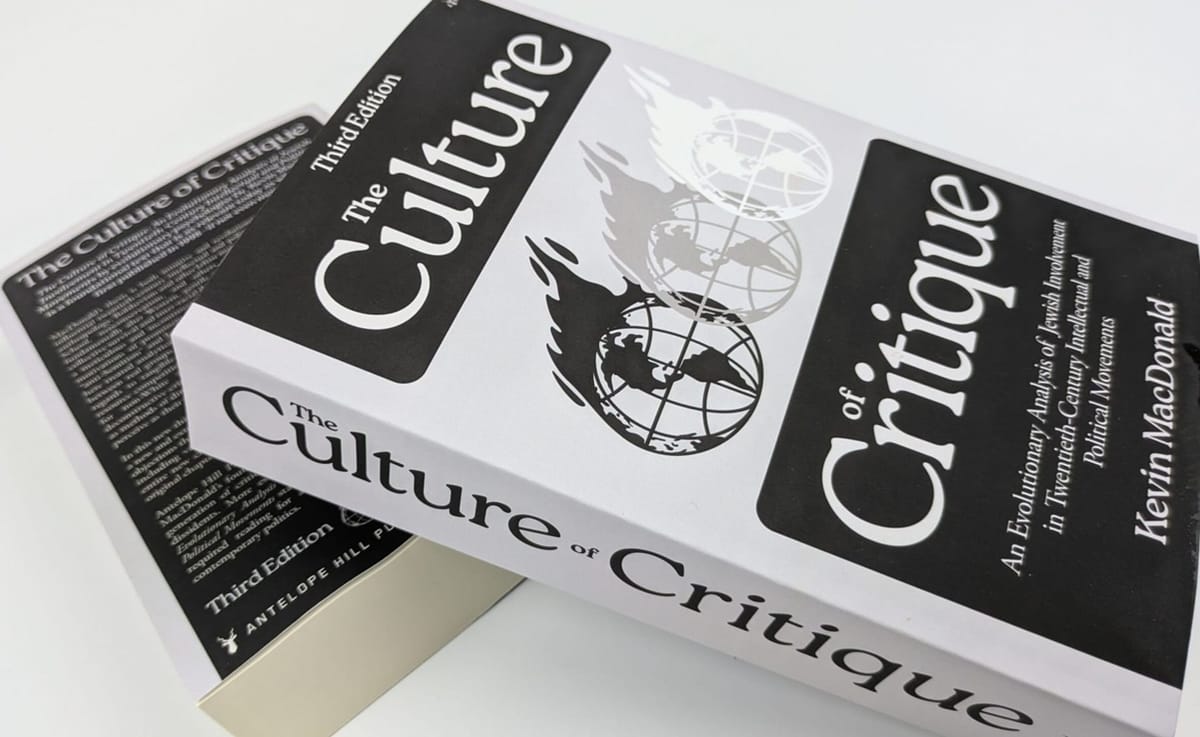
“[W]ith the rise of a Jewish elite hostile to traditional Christian authority, the moral community of the West has been fashioned by a media and academic culture that is hostile to the people and culture of the West—with disastrous consequences.”
—Kevin MacDonald, The Culture of Critique
If Giles Corey’s The Sword of Christ is the theological evaluation of Judaism’s impact on the Christian West, Dr. Kevin MacDonald’s The Culture of Critique is the sociological examination of the same phenomenon from an evolutionary perspective.
Like The Sword of Christ, The Culture of Critique is comprised of eight chapters, each addressing distinct movements that MacDonald argues function as critiques of Gentile culture: for example, Bolshevism as a critique of the monarchy; immigration reform as a critique of European-privileged race-based immigration to the U.S.; and neoconservatism as a critique of isolationist foreign policy. The third edition, significantly expanded and updated, testifies to the force of MacDonald’s argument. MacDonald’s tome should be considered the definitive source for an informed, complex critique of Jewishness’s impact on American culture. While its length is overwhelming at times, this is a must-peruse for any serious scholar of Jewish-European studies.
Technically, The Culture of Critique (CofC) is Dr. MacDonald’s third volume in a three-part series on Jewish evolutionary group dynamics. In 1994 he published A People That Shall Dwell Alone: Judaism as a Group Evolutionary Strategy, and in 1998 Separation and Its Discontents: Toward an Evolutionary Theory of Anti-Semitism. In these volumes, he posited that anti-Semitism arises as a reaction to Judaism’s cultural and genetic segregation and ethnocentrism that secures survival as underprivileged minorities. Traits such as high verbal intelligence, psychological intensity, and in-group solidarity enabled Jewish success in host societies but typically provoked gentile hostility. This is largely the arc of his first two works, which stretch back much further into the Middle Ages than The Culture of Critique.
By contrast, much of CofC focuses on the 20th century. For Jews dispersed across Europe and the United States at the start of the 1900s, the prior five centuries had been especially harsh, characterized by recurrent cycles of expulsion, forced conversions, economic restrictions, and pogroms, as I examined in my previous article, “From Ashes to Abundance: The Jewish Golden Age in America.” In it, I briefly noted how these difficult centuries birthed political Zionism as a nationalist response to antisemitism in the wake of WWII. However, additionally, MacDonald argues that as an international response, Jews participated heavily in leftist movements in the pre- and post-WWII United States with the specific aim of making these nations more tolerable for Jews. He attributes this involvement to a dual source: deep-seated resentment toward the Europeans who formed the majority in their host nations and who were often seen as the architects of ongoing oppression, combined with strategic self-interest as a minority ethnic group seeking to undermine societal structures that perpetuated their vulnerability. Persecution, whether justified or not, solidified an in-group identity that framed Europeans as inherent oppressors, positioning Jewish survival as dependent on serious, structural protections such as revolutionary ideologies aimed at eradicating class hierarchies and ethnocentrism, or separatist strategies like Zionism to establish a secure homeland.
Thus, it became essential to make the conditions for dispersed Jews as welcoming as possible. At the start of the 20th century things were much less welcoming for Jews. Racial quotas in Europe and America threatened Jewish upward mobility, and Jews were frequently unwelcome at WASP-heavy social clubs and societies. Puritanical social norms around sexuality suppressed licentious and progressive approaches to birth control, pornography, and gender theory—all industries where Jews were over-represented. U.S. immigration policy ensured that America would remain majority White, with pre-Hart-Celler Act policy privileging Europeans. Isolationist and nationalist foreign policy meant little hope of military support for the nascent state of Israel that was separated by an ocean and surrounded by adversaries. The ethnocentrism of Europeans and Russians was devastating to Jewish influence, with Russia establishing the Jewish Autonomous Oblast in 1936 that resettled around 50,000 Jews in the eastern USSR, and the Third Reich expelling around 400,000 Jews prior to the start of WWII. While it is worth noting that both efforts were somewhat voluntary on the part of the refugees, social coercion and economic incentives would have likely turned to bayonets and mandatory expulsions, as they began to in Poland, for example. In short, Jews were very close to being kicked out of Europe en masse. These traumatic decades burned into the psyche of Jewish immigrants who made for France, Britain, the Netherlands, and eventually the modern-day state of Israel, even after the climax of the war.
 Cody Justice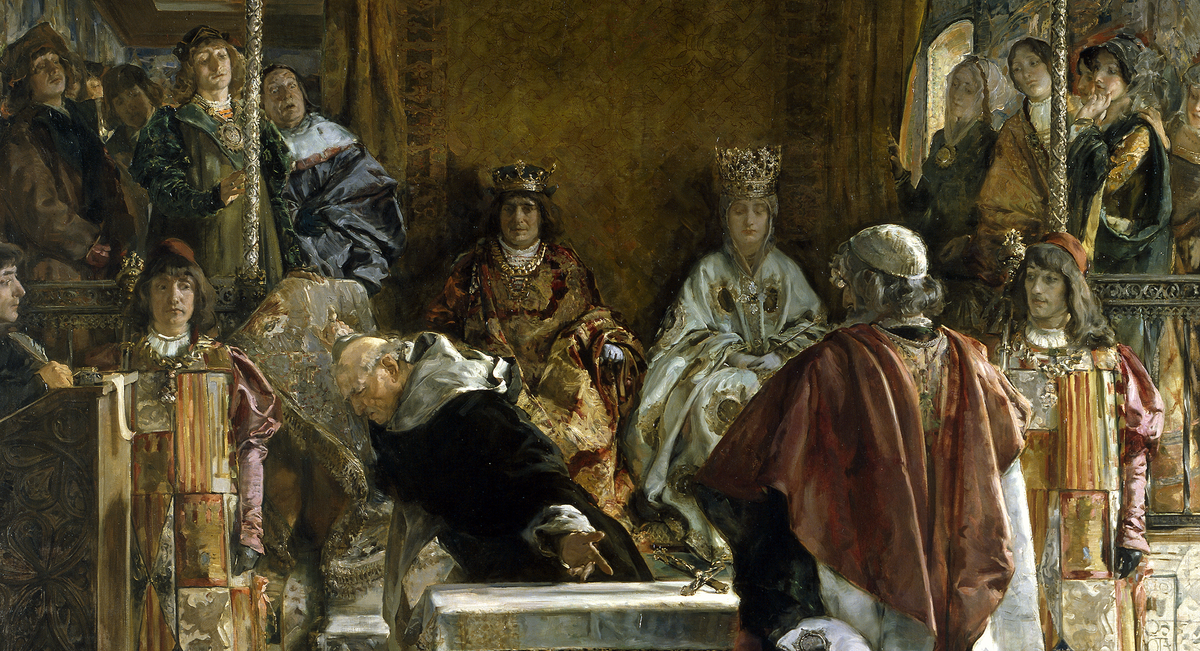
In response to unrelenting antisemitism in the 1800s and 1900s, and heightened tensions spilling into forced relocations and ostensible genocide in the middle of the 20th century, Jewish critiques (the so-called “Culture of Critique”) of Gentile (or Western) culture emerged, especially at the turn of century and heightening in the second half. These varied widely in scope, from politics to sexuality to monarchy, since, as noted above, their grievances with the WASP and Christian Europeans were multifactor and longstanding. For example, Freud and his predominantly Jewish followers framed Western (Gentile) society—particularly its Christian sexual ethics and family structures—as sources of neurosis, anti-Semitism, and fascism, stemming from suppressed sexuality and irrational traditions. The modern neoconservative movement in the U.S. subverted paleoconservative institutions to advance interventionist policies favoring Jewish interests over Gentile ethnocentrism as support for international Jewry from the USSR collapsed. At their core, each critique was leveled at Christian, European culture, or at the very least, was advanced explicitly to favor diaspora Jews. MacDonald notes:
Jews were unique as an American immigrant group in their hostility toward American Christian culture and in their energetic, aggressive efforts to change that culture. From the perspective of Henry Ford’s The International Jew, the United States had imported around 3.5 million mainly Yiddish-speaking, intensely ethnocentric Jewish immigrants over the previous forty years. In that very short period and long prior to achieving anything like the power they obtained after World War II and the 1960s counter-cultural revolution, Jews had had enormous effects on American society, particularly in their attempts to remove expressions of Christianity from public life beginning with an attempt in 1899–1900 to remove the word “Christian” from the Virginia Bill of Rights. (p. xxxii)
This framework helps explain historical tensions in the United States, and perhaps especially those being felt most today. Prior to the mid-20th century, American society was relatively homogeneous and dominated by White Anglo-Saxon Protestants (WASPs). Pre-World War II polls reflected underlying suspicions, with attitudes portraying Jews as untrustworthy or disloyal, with roughly half of enlisted personnel responding to one 1940 survey by agreeing “You can tell a Jew by the way he looks”, “A Jew will always play you for a sucker”, and that “Jews are the biggest goldbricks in the Army.” Goldbrick was a slang for individuals who did little work, but still collected pay. The 1965 Hart-Celler Act shifted immigration patterns, resulting in a reduction of the White population share from 88.6% in 1960 to 72.4% in 2010. This diversification heightened ethnic awareness, making Jewish distinctiveness—particularly perceived dual loyalty after Israel’s founding in 1948—more noticeable in a less uniform cultural landscape.
These factors and the fallout of Jewish-European relations following WWII form the bulk of CofC. Beyond psychoanalysis and neoconservatism, MacDonald identifies five additional critiques of Gentile culture: Boasian anthropology (a school of thought rejecting racial/biological determinism in explaining human differences), Jewish involvement in the left (including Bolshevism), the Frankfurt School of critical theory, the New York Intellectuals, and Jewish involvement in shaping U.S. immigration policy. His rigorous standards for designating these movements as “Jewish” lend significant credibility to his thesis. MacDonald does not rely solely on raw percentages of Jewish participation or self-ascriptions. Jews, ostensibly linked by descent to the original settlers of the Levant, vary in their affect, impulses, and motivations. Notably, some Jews fought against the Red Army in the Russian Civil War, and a number served in the German military during World War II. Resultantly, in MacDonald’s view, it is insufficient to highlight isolated actors or tenuous networks of financial and ideological connections. While explaining the Jewish connection to neoconservatism, MacDonald notes:
As with other Jewish intellectual and political movements, non-Jews have been welcomed into the movement and often given highly visible roles as the public face of the movement. This of course lessens the perception that the movement is indeed a Jewish movement, and it makes excellent psychological sense to have the spokespersons for any movement resemble the people they are trying to influence. (p. 205)
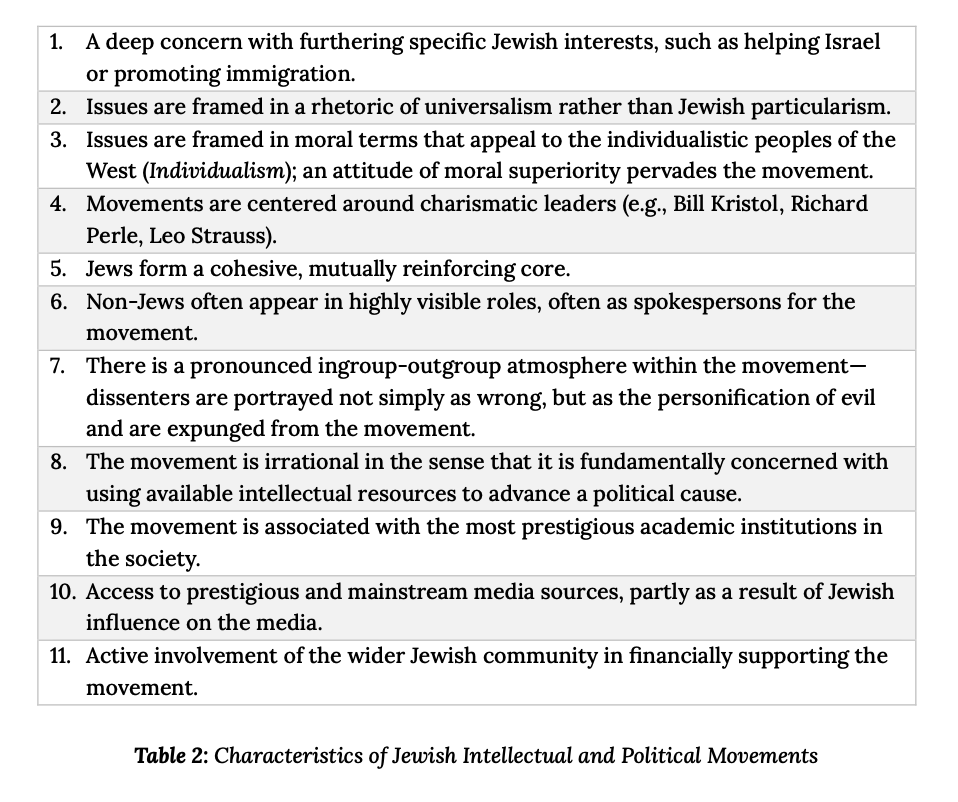
Therein lies the precision and brilliance of MacDonald’s work. He maintains that claims about the Jewish nature of movements critical of Gentile culture are most valid when supported by the evidence of significant (though not necessarily majority) Jewish involvement in leadership; backing from organized Jewish communities; and the movement’s self-conception as Jewish or, at minimum, oppositional to European traditions. As detailed below, MacDonald outlines eleven characteristics defining such Jewish intellectual and political movements. These criteria ensure rigorous identification, emphasizing ethnic overrepresentation, self-labeling as Jewish, and strategic opposition to Gentile ethnocentrism while promoting pluralism.
Jewish psychological intensity enabled a successful pursuit of universalizing particularist Jewish values, which Jews sought to frame as moral imperatives for society at large. By portraying themselves as a persecuted minority amid hostile Gentile majorities, Jewish intellectuals used guilt from Gentiles and solidarity with other Jews to leverage control over media and cinema. These mediums disseminated Jewish ideas that were critical of traditional Western structures (e.g., authoritarianism, nationalism, Christian sexual ethics) as pathological while advocating for pluralism, open immigration, and cultural relativism. These strategies diluted majority group boundaries and enhanced Jewish security. In the opening to Chapter 8, “Jewish Involvement in Shaping U.S. Immigration Policy,” MacDonald cites theater critic Walter Kerr to illustrate this cultural permeation:
What has happened since World War II is that the American sensibility has become part Jewish, perhaps as much Jewish as it is anything else. . . . The literate American mind has come in some measure to think Jewishly. It has been taught to, and it was ready to. After the entertainers and novelists came the Jewish critics, politicians, theologians. (p. 481)
Jewish dominance in Hollywood and intellectual circles normalized critiques of Gentile society, embedding themes of anti-racism and diversity that aligned with evolutionary goals of minimizing anti-Semitism through societal transformation.
Conclusion
CofC is masterly argued, thorough, and scholarly. As a sociological examination of Jewish culture in the modern West this is a must-read book. A 5/5 read. To be clear, not everyone needs to read this book, but whoever should read this book, must read this book. It is an essential guide to the world that has been made by the uncritical acceptance of Jews into European society.
While MacDonald is clear throughout that the antipathy of Jews is directed not just at Europeans, but primarily at Christian Europeans, it bears repeating at the end that his thesis and observations are doubly confirmed by the witness of Scripture. We would expect those who claim to be Jews to persist in their stubbornness against Christ, as they did throughout his earthly ministry and during the time of the Apostles. While the sons of Japheth (Europeans) quickly welcomed Christ, and he blessed them greatly, the Jews grew all the angrier, like the older brother of the prodigal son. The manifestation of scathing, bitter critiques of Gentile culture is anticipated and expected from these long-time enemies of the cross. The question is, will Whites find it in themselves to reject these critiques? Will we have a resolve to hold to our tradition and Christian heritage?
Our civilization hangs in the balance.
“To a considerable extent, the current malaise of Whites in the U.S. can be directly traced to the triumph of a new, substantially Jewish elite.”
—Pg. 12
Note: An older audiobook of The Culture of Critique is available on YouTube for listening here: Playlist. If you enjoy the content, consider purchasing the third edition of the The Culture of Critique from Antelope Hill Publishing.